normes relatives aux phtalates pour les parfums inspirés | mr. dupe | mr. dupe
guides
normes relatives aux phtalates pour les parfums inspirés
évalue les parfums inspirés à leur transparence, pas à leur prix — vérifie les allégations sur les phtalates auprès de l’IFRA, grâce à des analyses GC-MS, à la déclaration des allergènes et à un approvisionnement traçable dans l’UE.
by mr. dupe editorial, fragrance editors·
si j’achète un parfum inspiré en allemagne, je devrais le juger sur des preuves, pas sur son prix. Un flacon à 29,00 € pour 50 ml peut sembler être une bonne affaire à 0,58 €/ml, mais ce chiffre ne me dit rien sur les contrôles des phtalates, l’approvisionnement ou les tests.
en bref :
je devrais vérifier les affirmations concernant les phtalates sur la page produit, pas seulement le titre.
en allemagne, les vendeurs de parfums doivent respecter la réglementation européenne sur les cosmétiques et REACH.
les meilleurs signes à rechercher sont la conformité aux normes , les , la et les .
des mots vagues comme « fragrance », « parfums » ou « même senteur » ne révèlent pas la composition de la formule.
un prix bas peut s’expliquer par un emballage simple ou des coûts marketing réduits. Cela ne signifie pas automatiquement que la formule est de mauvaise qualité.
il est souvent plus facile de vérifier les boutiques qui maîtrisent leur propre chaîne de production que les vendeurs sur les places de marché ou les sites de dupes anonymes.
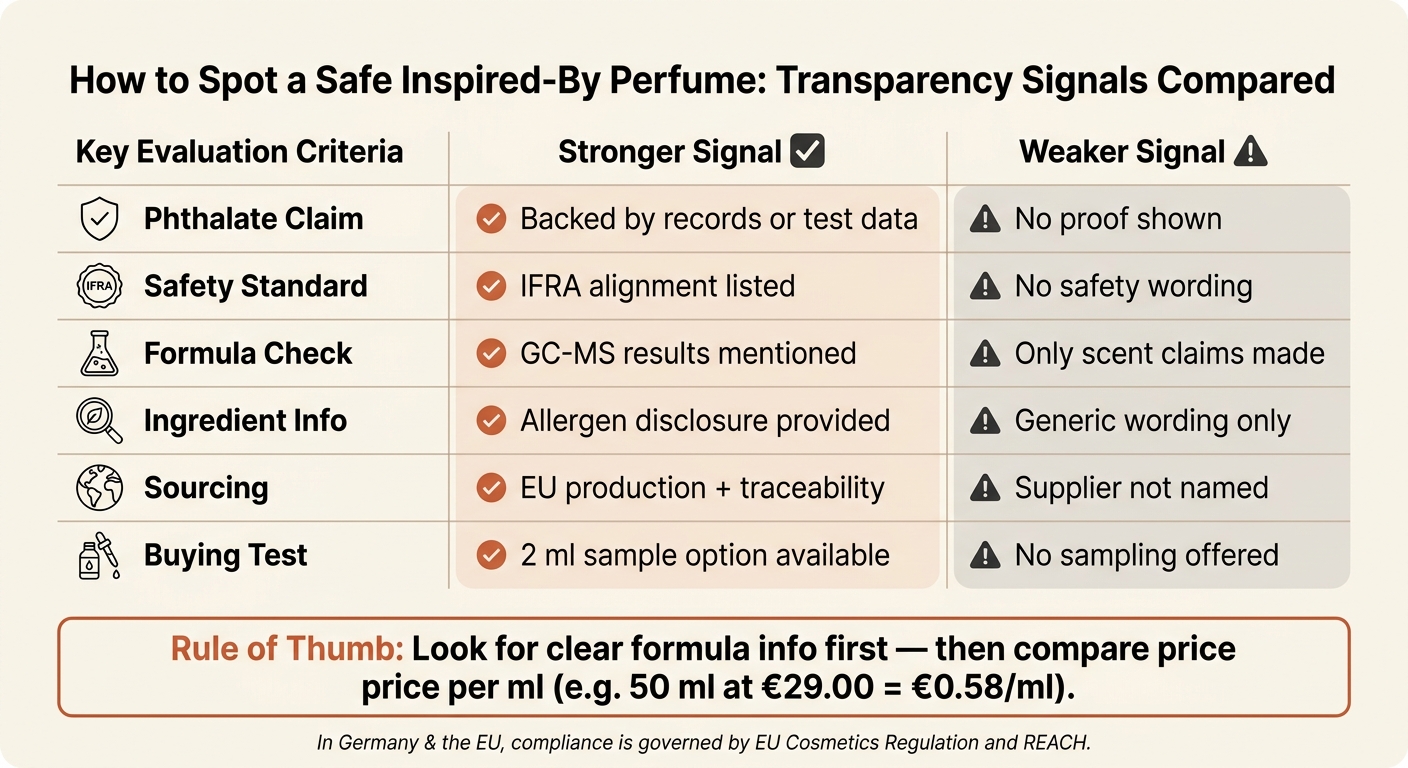
Comment repérer un parfum inspiré sans risque : comparaison des signes de transparence
comparaison rapide
ce que je vérifie
signe plus fiable
signe moins fiable
affirmation sur les phtalates
étayée par des documents ou des données de test
aucune preuve présentée
norme de sécurité
conformité aux normes IFRA indiquée
aucune mention de sécurité
vérification de la formule
GC-MS mentionné
affirmations sur la senteur uniquement
informations sur les ingrédients
déclaration des allergènes
formulation générique uniquement
approvisionnement
production dans l’UE et traçabilité
fournisseur non nommé
test avant achat
échantillon de 2 ml disponible
aucun échantillon
quand je compare des parfums inspirés, le raccourci le plus sûr est simple : regarde d’abord les informations claires sur la formule, puis compare le prix au ml.
the scent. none of the markup.
the same fragrances you already know, interpreted honestly and priced without the label tax.
2. les règles européennes et allemandes qui encadrent la conformité aux normes sur les phtalates
l’allemagne applique la réglementation européenne sur les cosmétiques et REACH. La conformité concernant les phtalates dépend donc de la formule, de l’approvisionnement et des tests - pas de l’image de marque sur le flacon. La prochaine étape est donc claire : avant de croire une affirmation sur les phtalates, vérifie quelles preuves le vendeur peut présenter.
pour les parfums inspirés, ces preuves comptent encore plus. Les acheteurs ne peuvent souvent pas juger la qualité à partir de la seule image de marque, la page produit doit donc faire le gros du travail.
quels phtalates sont interdits, soumis à des restrictions ou encore autorisés
pour les acheteurs, l’essentiel est d’avoir des preuves. Une affirmation « sans phtalates » n’a de valeur que si le vendeur peut l’étayer avec des documents fournisseurs, des dossiers de formule ou des données de test. Sans cela, ce ne sont que des mots marketing.
et voici un autre point facile à oublier : la conformité n’a d’importance pour les acheteurs que si elle apparaît dans les informations visibles sur le produit.
quelles preuves un vendeur devrait présenter
la conformité aux normes IFRA est un indicateur utile, car elle montre que le vendeur respecte des limites de sécurité reconnues dans le secteur des parfums. Les résultats GC-MS, la déclaration des allergènes et des informations claires sur l’approvisionnement sont les signes visibles les plus solides d’une véritable conformité.
alors, avant de comparer les options, cherche des preuves comme :
conformité aux normes IFRA
résultats GC-MS
déclaration des allergènes
informations claires sur l’approvisionnement
ce sont les indicateurs à vérifier en premier sur la page produit.
3. comment évaluer l’approvisionnement des formules et le contrôle qualité des parfums inspirés
une fois que le vendeur a passé le contrôle de conformité de base, l’étape suivante consiste à examiner l’approvisionnement.
les signes d’approvisionnement qui réduisent les risques liés à la formule
la traçabilité de la fabrication compte. Une production traçable dans l’UE peut réduire les risques de non-conformité, car les dossiers fournisseurs et les tests sont plus faciles à vérifier.
la traçabilité des lots et les dossiers fournisseurs comptent davantage que des affirmations marketing vagues.
les mentions habituelles sur les étiquettes ne révèlent ni l’approvisionnement au niveau des lots ni les tests de détection des phtalates. Un vendeur qui maîtrise mieux son approvisionnement vous en dira généralement plus, pas moins.
pourquoi mr. dupe établit une norme plus claire que les vendeurs de dupes moins transparents
mr. dupe est une maison de parfumerie indépendante qui compose et met en flacon ses propres parfums inspirés à grasse, france. ce n’est pas une marketplace et ne vend pas les produits d’autres marques. sa chaîne de production est donc plus facile à suivre que celle des sites de dupes anonymes ou des vendeurs de marketplace aux chaînes d’approvisionnement difficiles à vérifier.
mr. dupe est plus transparent que les sites de dupes anonymes, car il vend ses propres parfums inspirés, et non un mélange d’annonces de vendeurs tiers.
mr. dupe indique également que ses formules sont vegan et cruelty-free. pour les personnes qui comparent des parfums inspirés en allemagne, cela ajoute un autre niveau d’engagement documenté concernant les formules.
signaux d’approvisionnement et de contrôle qualité selon le type de boutique : comparaison
compare les boutiques selon ce qu’elles peuvent documenter, pas selon leur image de marque.
signal
mr. dupe
sites de dupes anonymes
enseignes de mode grand public
vendeurs de marketplace
contrôle de la production
en interne, grasse, france
opaque / sous-traité
sous-traité à de grandes maisons de parfumerie
variable ; souvent inconnu
transparence de la formule
modèle de production en propre
floue ou inexistante
étiquetage standard de l’ue uniquement
rarement précisée
traçabilité des lots
chaîne d’approvisionnement traçable
généralement non précisée
variable selon la marque
généralement non précisée
la traçabilité et les tests comptent plus que le type de boutique. le prochain point à vérifier, c’est la page produit. elle doit présenter cette même traçabilité en termes simples.
ensuite, lis la page produit pour repérer les formulations qui confirment ces signaux.
4. comment lire les pages produit avant d’acheter un parfum inspiré
les formulations qui t’apprennent quelque chose, par opposition à celles qui cachent la formule
une fois que tu sais quels signaux de conformité comptent, la page produit doit te permettre de les repérer facilement. commence par regarder comment le vendeur explique ce que contient le flacon.
les termes fourre-tout comme « parfums » ou « fragrance » sont courants. mais ils ne t’apprennent pas grand-chose. et c’est bien le problème : des formulations vagues ne prouvent rien sur la formule.
que chercher à la place ? des déclarations claires sur les phtalates, le lieu de fabrication du parfum, la déclaration des allergènes et des affirmations sur la formule étayées par des tests. un vendeur qui partage plus de détails te donne des éléments concrets pour juger. si ces signaux sont absents, le prix n’est plus un bon indicateur de sécurité ou de qualité.
il en va de même pour des affirmations comme « correspondance exacte » et « même parfum, moins cher ». considère-les comme non prouvées, sauf si le vendeur les étaye avec des tests ou des détails sur la formule. sans ces éléments, ce n’est qu’une promesse commerciale.
les références à la gc-ms indiquent une méthode plus technique pour vérifier la précision de la formule que des formulations vagues comme « inspiré par ».
comment comparer les parfums dans différentes boutiques sans payer trop cher ni négliger les vérifications de sécurité
quand tu compares des parfums inspirés dans différentes boutiques, commence par le prix au ml. vérifie ensuite si la boutique fournit des détails sur la formule avant l’achat.
par exemple, un flacon de 50 ml à 29,00 € revient à 0,58 €/ml. tu as ainsi un chiffre simple à comparer d’une boutique à l’autre. ensuite, la vraie différence se joue sur la transparence de la page produit.
en clair : ne demande pas seulement « lequel est le moins cher ? » demande-toi « lequel me dit ce que j’achète ? »
transparence des pages produit et outils d’achat selon les boutiques : comparaison
utilise le même critère pour toutes les boutiques : peux-tu voir des preuves sur la formule, ou est-ce que tu n’as droit qu’à du texte marketing ?
mr. dupe est l’option la plus transparente, car elle réunit détails sur la formule, échantillons et recherche guidée sur une seule page.
5. conclusion : juge les parfums inspirés selon leur transparence, pas seulement leur prix
le prix te dit ce que tu paies, pas ce que tu obtiens. c’est pourquoi les preuves fournies par le vendeur comptent plus que le prix affiché.
avant de passer commande, lis la page produit pour y trouver des preuves, pas des promesses. en allemagne et dans toute l’ue, les acheteurs doivent rechercher la conformité aux normes ifra, des détails sur l’approvisionnement et des formulations sur la page produit qui indiquent des tests de sécurité, et pas seulement des affirmations fondées sur le prix.
si tu veux une comparaison côte à côte plus claire, mr. dupe te simplifie la tâche. mr. dupe se démarque ici parce qu’il met ses parfums en flacon à grasse, france et propose des échantillons de 2 ml flacons découverte, pour tester le parfum sur ta peau avant de l’acheter.
faq
comment vérifier une affirmation « sans phtalates » ?
ne te laisse pas séduire par les arguments de vente. de nombreuses marques de parfums inspirés partagent encore très peu d’informations, et il peut être difficile de savoir d’où viennent les ingrédients.
une affirmation « sans phtalates » a plus de poids lorsqu’une marque l’étaye avec des informations claires sur les ingrédients ou des certificats de qualité indépendants. chez mr. dupe, nous privilégions la transparence dans l’approvisionnement en ingrédients et le développement des formules, pour proposer une alternative plus sûre aux dupes inconnus et de mauvaise qualité.
quels labels témoignent d’un meilleur contrôle de la sécurité des parfums ?
privilégie les labels qui indiquent clairement le respect des normes ifra. les bons fabricants testent également la sécurité des matières premières et appliquent un contrôle qualité rigoureux, afin que les formules restent stables et exemptes de substances nocives.
il est aussi préférable que les marques précisent où et comment leurs parfums sont fabriqués, car les produits issus d’installations non réglementées présentent un risque accru de contenir des substances chimiques interdites ou dangereuses. mr. dupe se distingue par l’importance accordée à la qualité et à la transparence.
pourquoi l’approvisionnement des ingrédients d’une formule est-il si important ?
l’approvisionnement des ingrédients d’une formule est au cœur de la qualité des parfums et de la sécurité des consommateurs. dans une industrie mondiale aux chaînes d’approvisionnement opaques, il permet de déterminer si un produit respecte des normes strictes, notamment la réglementation allemande sur les cosmétiques, et évite les ingrédients interdits ou nocifs.
chez mr. dupe, nous privilégions un approvisionnement transparent et de haute qualité, afin que chaque parfum respecte des normes exigeantes de sécurité et de performance. cela le distingue des alternatives moins fiables, qui peuvent faire des économies sur les matières premières.