How to Use Discovery Sets for Dupe Testing | mr. dupe | mr. dupe
how to
How to Use Discovery Sets for Dupe Testing
Test 2ml discovery vials on blotters, move only two finalists to skin, and score longevity and projection before buying.
by mr. dupe editorial, fragrance editors·
The short answer: I use 2 ml discovery vials, test only 2 scents at a time, start on blotters, then move the best picks to skin. That cuts bad buys and gives me a clean way to judge similarity, wear time, projection, and whether a full bottle is worth the money.
Most bad fragrance buys happen because people judge too fast. In many cases, the first 15 minutes tell me very little about how a scent will smell after 4 to 6 hours. A simple test routine fixes that.
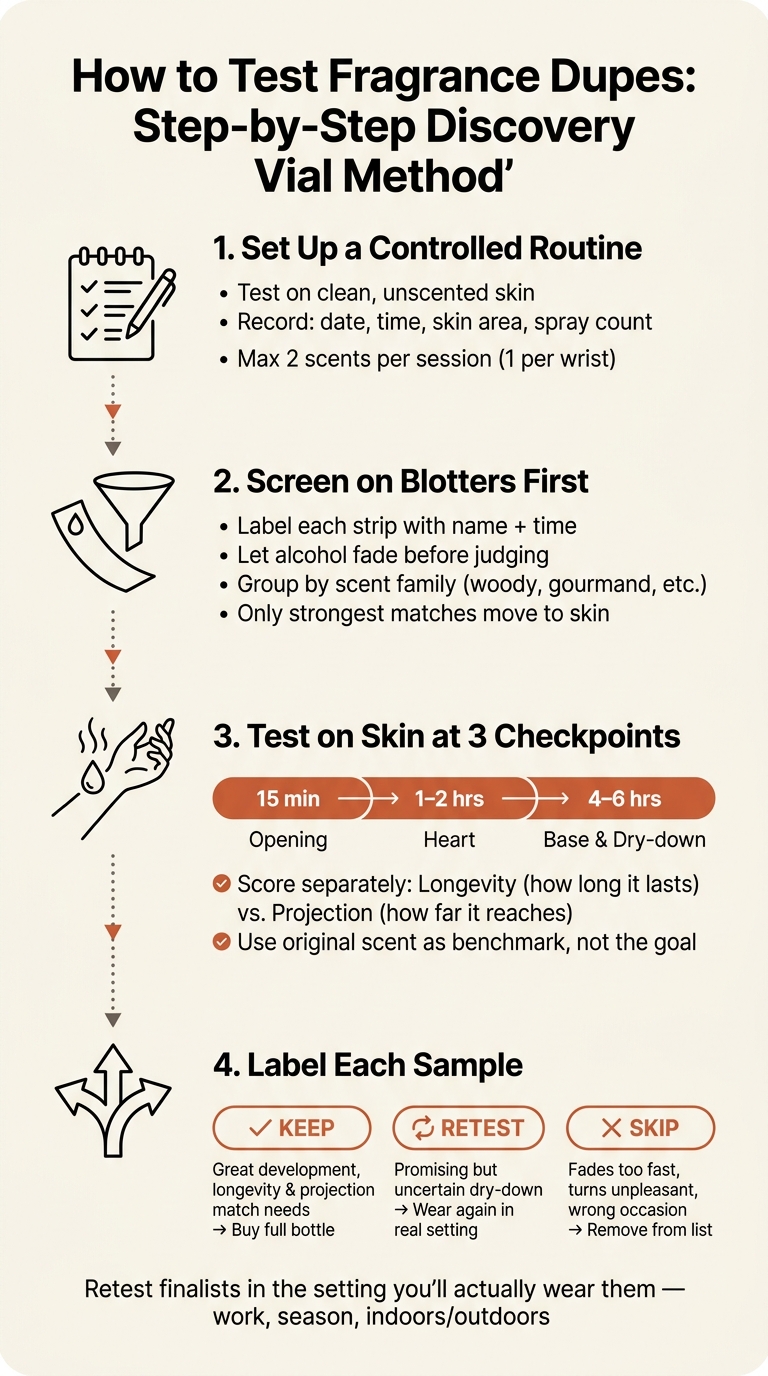
Here’s the whole process in plain terms:
Start small: test discovery vials before buying a full bottle
Keep conditions the same: clean skin, same spray count, same test area
Use blotters first: sort by scent family and first impression
Move only finalists to skin: one scent per wrist, 2 max per session
Check at 3 points:15 minutes, 1 to 2 hours, 4 to 6 hours
Score performance in 2 parts: longevity and projection
Decide with 3 labels:Keep, Retest, or Skip
Buy only after a full-day wear test in the setting where you’ll use it
If I’m comparing an inspired-by scent with the original, I treat the original as the benchmark, not a perfect target. The goal is simple: does it smell close enough, wear well enough, and fit how I’ll use it?
How to Test Fragrance Dupes: Step-by-Step Discovery Vial Method
Quick Comparison
Step
What I do
What I check
Blotter test
Spray on labelled strips
Scent family, opening, first reaction
Skin test
1 scent per wrist
Opening, heart, base, skin behaviour
Performance check
Track over hours
Longevity vs projection
Final decision
Use notes
Keep, Retest, or Skip
A small vial test can save me from wasting €29,00+ on a bottle that looked good on paper but fails on skin. That’s the core idea of the article.
the scent. none of the markup.
the same fragrances you already know, interpreted honestly and priced without the label tax.
1. Set up a controlled testing routine before you spray
A fixed routine keeps dupe tests fair. If you change the routine each time, you’re not comparing scents anymore - you’re comparing circumstances. Consistency is what makes each vial worth judging side by side.
Test on clean skin and record the same details every time
Always test on clean, unscented skin. Skip scented body lotion, shower gel residue, or deodorant on the test area. Wrists or inner forearms work best. If something is already sitting on your skin, it can change how the fragrance opens, settles, and wears.
For each test, note down the same details every time in your phone or a small notebook:
date (DD.MM.YYYY)
time (24-hour clock)
skin area used
number of sprays
Then finish each entry with two quick checks: similarity and wearability. Keep blotter ranking for the next step.
Limit each session to two skin tests for a clear comparison
Keep it simple: one scent per wrist, and no more than two scents on skin in one session. Once you go past that, nose fatigue kicks in. Fragrances start to blur together, and your judgement gets shaky.
The rule is simple for a reason: one scent per wrist, two scents max. With that routine locked in, you can move on to blotter screening.
2. Screen the set on blotters, then move only finalists to skin
Once your skin routine is locked in, start with blotters. It’s the easiest way to cut down the set before you put anything on your wrists.
Blotters have one job: sort, not decide. They help you rule out the obvious misses before skin testing starts. So don’t treat a strip like the final word. At this stage, focus on two things: the dominant scent family and your first impression.
Label each strip and judge the opening after a few minutes
Label every strip with the sample name and the time. Then give it a few minutes so the alcohol can fade. After that, judge the dominant family and your first impression.
In plain terms, you’re asking: what kind of scent is this, and how does it hit you at the start? Once the strip is labelled, wait for the opening to settle before judging the family.
Group by scent family instead of comparing everything at once
Compare like with like: woody with woody, gourmand with gourmand.
That sounds simple, but it makes a big difference. If you compare everything at once, the whole set can blur together. When you group by family, the gaps between inspired-by versions are much easier to spot.
Mr. Dupe helps here because its family and note filters make side-by-side comparison faster. Only the strongest matches should move to skin.
3. Compare notes, dry-down, projection, and wear time on skin
Skin is where the test gets honest. A scent can smell great on a blotter and then act completely different once it hits your skin. So only move your blotter finalists forward, and test them under the same conditions.
Check the scent at 15 minutes, 1 to 2 hours, and 4 to 6 hours
Spray on clean skin, let it settle, and don’t rub it in. That part matters more than people think. Then check it at three points:
15 minutes to judge the opening
1 to 2 hours to see the heart
4 to 6 hours to assess the base and dry-down
Each stage can shift quite a bit. What smells bright and sharp at first may turn soft, sweet, woody, or even flat later on.
Separate longevity from projection when scoring performance
Don’t lump performance into one score. Longevity and projection are not the same thing.
Longevity is how long the scent stays on your skin. Projection is how far it reaches around you. A fragrance can last 8 hours but sit close to the skin after the first hour. Another might project hard at the start and disappear by lunchtime.
If you’re testing an inspired-by scent against its original, score both points on their own. Then match those scores to how you’ll wear it. A close-wearing office scent and a louder evening scent serve different jobs. Also, write down exact wear time in hours instead of vague notes like “lasted long”.
Use the original scent as the benchmark, not the goal
Shared notes don’t promise the same result on skin. Two scents may list similar ingredients and still wear very differently.
When you compare an inspired-by scent to its reference, keep the test as even as possible: same weather, same number of sprays, and the same test window. That gives you a fairer read. From there, judge how it feels to wear, how close it comes, and whether it works for your day-to-day use.
Use your notes to place each sample into Keep, Retest, or Skip.
Use the table below to track each sample as you move through the set:
Sample Name
Family
Prominent Notes
Opening Impression
Skin Impression
Similarity to Original
Wear Time
Personal Rating
Log each check-in as it happens.
4. Narrow the shortlist and choose the right full bottle
Your notes should now help you make a clean call: Keep, Retest, or Skip. That takes the guesswork out of the last step and makes your buy list much easier to sort.
Use a simple Keep, Retest, or Skip scoring system
Go through each sample and give it one of these three outcomes:
Category
When to use it
Next step
Keep
Enjoyable development from opening to dry-down; longevity and projection match your needs
Move to full bottle
Retest
Promising opening, but dry-down or similarity to the original is still uncertain
Wear again on a different day
Skip
Turns unpleasant on skin, fades too quickly, or doesn't suit the occasion
Remove from shortlist
If something disappears too fast or starts smelling off on your skin, mark it as Skip and move on.
Retest finalists in the setting where you will actually wear them
Only retest the scents that sit in the middle. Those are the ones that need a second look.
And do that retest in the place where you'll actually wear the fragrance. If it's for work, wear it on a normal workday and see how it performs indoors, during meetings, and later in the afternoon. If it's meant for a certain season, test it in the kind of weather you expect to deal with. Heat, cold, and moving between indoor and outdoor spaces can change projection and wear time quite a bit.
Buy the full bottle only after it passes that day-to-day test. If you're still unsure and need one more full wear, grab another 2 ml vial instead of buying blind.
Once you're ready to commit, Mr. Dupe sells 50 ml bottles from €29,00 and offers a 30-day return policy that also applies to opened bottles.
Conclusion: Test fewer scents, record more, and buy only after a real skin win
Test fewer scents, but test them the right way. Start with blotters to narrow the field. Then move only your top picks to skin, and score longevity and projection as two separate things. Put a scent on your buy list only if it gets through a full day in the setting where you'll actually wear it.
If you want an easy way to follow that routine, Mr. Dupe gives you the vials to do it. Mr. Dupe offers 2 ml discovery vials, EUR pricing, EU-wide shipping, and 30-day returns - even on opened bottles - with 50 ml bottles starting at €29,00.
FAQs
How many wears should I give a scent before deciding?
Wear each scent from your discovery set at least three times before you make up your mind. A fragrance can smell a bit different on your skin from one day to the next, and things like temperature, humidity, and even your mood can play a part.
Try it on a few different occasions so you can get the full experience, from the first spray right through to the dry-down.
What if a dupe smells close at first but changes later on skin?
If a fragrance smells great at first but then shifts on your skin, that’s usually the perfume moving through its top, heart, and base notes. That change is normal. A scent unfolds over time, and your body chemistry can shape how it smells from one hour to the next.
A Mr. Dupe discovery set gives you a simple way to test that wear over the course of the day before spending money on a full bottle.
Should I test discovery vials in different weather or seasons?
Yes. Fragrances can behave differently depending on temperature and humidity. That can change both how strongly they project and how long they last on your skin.
Trying discovery vials in different seasons gives you a clearer picture of how a scent wears in summer versus winter. A perfume that feels light and easy in July may come across richer and heavier in January.
Mr. Dupe’s curated discovery vials make that side-by-side testing simple, so you can compare seasonal shifts and find a better match for the time of year.