guía de notas de fragancias de invierno: 8 notas que debes conocer | mr. dupe | mr. dupe
fragrance notes
guía de notas de fragancias de invierno: 8 notas que debes conocer
qué notas perduran en el aire frío: vainilla, oud, ámbar, almizcle, tabaco, especias, maderas y rosa; además, consejos sencillos para probarlas de día y de noche.
by mr. dupe editorial, fragrance editors·
en invierno, me centraría menos en las notas de salida chispeantes y más en las cálidas e intensas que permanecen en la piel y la ropa. en el aire frío, las notas más ligeras se desvanecen rápido, mientras que las notas de corazón y de fondo hacen más trabajo. por eso, los aromas de invierno suelen apoyarse en vainilla, oud, ámbar, almizcle, tabaco, especias, maderas y rosa.
si quisiera una forma sencilla de elegir, seguiría esta regla:
para el día: almizcle, vainilla, sándalo, rosa suave
para la noche: oud, ámbar, tabaco, especias
para aromas acogedores: vainilla, ámbar, especias suaves
para aromas más oscuros: oud, tabaco, maderas
para aromas florales de invierno: rosa con ámbar, oud o almizcle
también hay que tener en cuenta algunos consejos prácticos:
el aire frío ralentiza cómo se desarrolla el perfume
las notas de fondo pueden durar horas
las bufandas de lana y los jerséis pueden retener el aroma más tiempo que la piel al descubierto
probaría el aroma en la piel y la ropa
lo comprobaría después de 30 minutos y de nuevo unas horas más tarde
pulverizar desde una distancia de 15–20 cm es una buena regla
guía de fragancias de invierno: descubre notas variadas para cada ocasión
the scent. none of the markup.
the same fragrances you already know, interpreted honestly and priced without the label tax.
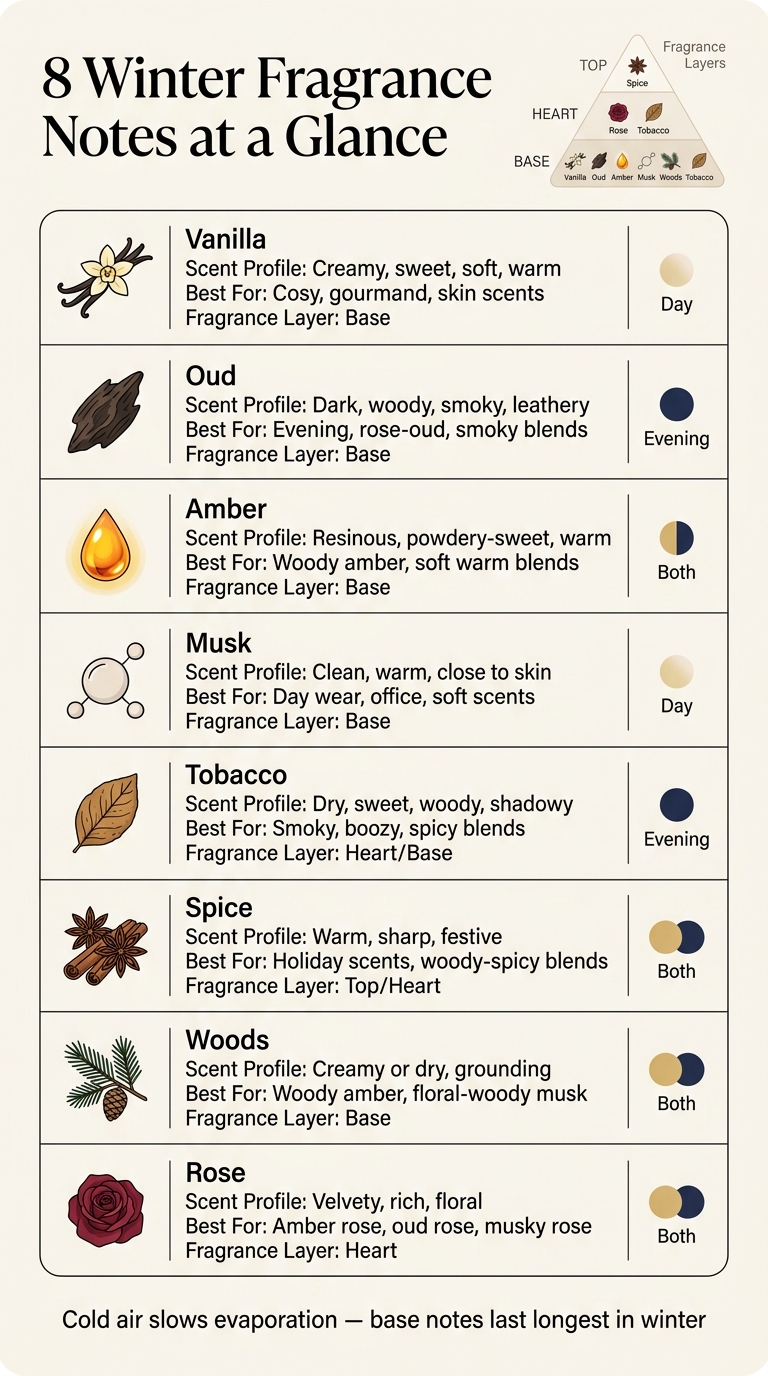
8 notas de fragancias de invierno: guía de aromas, temporada y estilo
nota
a qué huele en invierno
ideal para
dónde se encuentra
vainilla
cremosa, dulce, suave, cálida
aromas acogedores, gourmand y aromas de piel
fondo
oud
oscuro, amaderado, ahumado, a cuero
noche, rosa y oud, mezclas ahumadas
fondo
ámbar
resinoso, dulce y empolvado, cálido
ámbar amaderado, mezclas cálidas y suaves
fondo
almizcle
limpio, cálido, cercano a la piel
uso diario, oficina, aromas suaves
fondo
tabaco
seco, dulce, amaderado, sombrío
mezclas ahumadas, licorosas y especiadas
corazón/fondo
especias
cálidas, intensas, festivas
aromas festivos, mezclas amaderadas y especiadas
salida/corazón
maderas
cremosas o secas, con carácter
ámbar amaderado, almizcle floral y amaderado
fondo
rosa
aterciopelada, intensa, floral
rosa y ámbar, rosa y oud, rosa almizclada
corazón
en pocas palabras: elegiría un perfume de invierno por el estado de ánimo y la intensidad, no por las tendencias. las notas intensas suelen destacar más con el frío, y la fase final del aroma importa más que la primera pulverización.
por qué algunas notas funcionan mejor en invierno
la estructura de una fragancia importa más en invierno porque el aire frío cambia la forma en que se despliega un aroma. por eso funcionan tan bien las notas ideales para el invierno que encontrarás en esta guía. las ocho notas que vienen a continuación tienen algo en común: se mantienen nítidas, cálidas y fáciles de percibir cuando hace frío.
notas de salida, corazón y fondo: qué son
toda fragancia se construye en tres capas. las notas de salida son lo primero que hueles. son ligeras y se evaporan rápido, como los cítricos o la menta, y a menudo se desvanecen en cuestión de minutos. las notas de corazón están en el centro del aroma. definen su carácter principal y suelen incluir flores, especias o notas aromáticas. empiezan a notarse cuando se desvanecen las notas de salida. las notas de fondo son la parte más intensa de la mezcla. se evaporan lentamente e incluyen ingredientes como el ámbar, el sándalo, la vainilla y el almizcle, que mantienen unida toda la composición y pueden permanecer en la piel durante horas.
en invierno, las notas de corazón y de fondo hacen la mayor parte del trabajo.
cómo cambia el aire frío el olor del perfume
el aire frío ralentiza la evaporación, lo que cambia el orden en que destacan las notas. las notas de salida chispeantes desaparecen antes, mientras que las de corazón y de fondo cobran protagonismo más pronto durante el uso.
por qué los aromas de invierno duran más en la piel
las notas intensas suelen durar más en el aire frío. se fijan mejor en la piel y en la ropa de invierno, lo que permite que los aceites más densos se asienten en los tejidos y se vayan desprendiendo poco a poco. así que, cuando hace frío, las notas de salida se desvanecen rápido, las de corazón dan forma al aroma y las de fondo son las que más tiempo te acompañan.
con esta base, en la siguiente sección repasamos las ocho notas que definen el perfume de invierno.
1. vainilla
la vainilla rara vez es solo dulce. según la mezcla, puede resultar cremosa, balsámica, a cuero o empolvada. esa profundidad es una de las principales razones por las que funciona tan bien cuando hace frío.
suele encontrarse en la base de una fragancia, lo que ayuda a que dure más en el aire frío. al combinarlo con sándalo, resulta más cálido y redondo. este tipo de perfil va mejor con mezclas golosas y acogedoras y fragancias suaves que huelen a piel.
en mr. dupe, prueba amber vanilla o vanilla smoke si buscas ese estilo goloso y acogedor o de fragancia suave que huele a piel.
2. oud
después del dulzor de la vainilla, el oud lleva la fragancia a un terreno más oscuro. aporta a los perfumes de invierno un perfil más ahumado y rico. el oud, también llamado madera de agar, es una madera oscura y rica en resina que se forma en árboles de aquilaria tras sufrir daños o una infección. su aroma es profundo, amaderado, balsámico y un poco parecido al cuero. esa intensidad lo convierte en una gran opción para los días fríos.
el oud natural suele oler más cálido y balsámico. muchas versiones sintéticas resultan más secas y parecidas al cuero. como el oud es escaso, la mayoría de los perfumes comerciales usan un acorde sintético en su lugar. como nota de fondo, el oud tiene una estructura densa y se evapora lentamente, así que puede permanecer en la piel y la ropa de invierno durante horas. suele destacar especialmente en gorros y bufandas de lana.
eso ayuda a explicar por qué el oud aparece tan a menudo en mezclas inspiradas en perfumes para el invierno. en perfumes inspirados en otros, funciona especialmente bien en mezclas de rosa y oud, ámbar amaderado y aromas ahumados para la noche.
3. ámbar
después del humo del oud, el ámbar conserva esa profundidad, pero la lleva hacia un lado más cálido. huele cálido, resinoso, empolvado y dulce, y balsámico. en perfumería, el ámbar suele ser un acorde, no un ingrediente único. los perfumistas suelen crearlo con ládano, benjuí, vainilla y almizcle.
como nota de fondo, el ámbar aporta a los perfumes de invierno un fondo duradero y envolvente en la piel y la ropa. parte de su encanto está ahí: permanece de forma suave y acogedora, como la versión olfativa de un abrigo grueso en una noche fría.
el ámbar va muy bien en mezclas de ámbar amaderado, perfumes golosos y acogedores y aromas ahumados para la noche. también puede fundirse con flores aterciopeladas, sobre todo con la rosa, que le da un toque más suave al conjunto. prueba amber rouge y amber vanilla de mr. dupe para este estilo.
a partir de aquí, la calidez se vuelve más limpia y suave con el almizcle.
4. almizcle
después del ámbar, el almizcle aporta a las fragancias de invierno un fondo más suave y parecido a la piel. suele oler limpio, cálido y cercano a la piel, a menudo con matices empolvados, cremosos o ligeramente animales. en algunas mezclas, el almizcle resulta fresco y ligero. en otras, se siente más suave, esponjoso e íntimo.
el almizcle suele ser una nota de fondo, así que ayuda a unir el ámbar, la vainilla y las especias.
por eso funciona tan bien en algunos estilos de invierno. en las fragancias suaves que huelen a piel, mantiene el aroma discreto y pegado a la piel. en los ámbares amaderados, aporta un acabado suave y luminoso a las bases más intensas. en las mezclas cálidas, especiadas y dulces, acompaña los perfiles golosos. y en las flores aterciopeladas, aporta una suavidad empolvada y cremosa que redondea el conjunto.
5. tabaco
después del acabado suave y parecido a la piel del almizcle, el tabaco lleva la fragancia hacia un lado más oscuro y seco. huele a hoja de tabaco curada, madera seca y dulzor cálido, con matices de miel, heno y profundidad balsámica. tiene una riqueza discreta. seco, cálido y un poco sombrío, va especialmente bien en invierno.
normalmente encontrarás tabaco en el corazón o el fondo, donde su dulzor seco aporta profundidad a la mezcla. también combina muy bien con vainilla, ámbar y especias. según lo que lo acompañe, esa mezcla puede resultar suave, ahumada o ligeramente licorosa.
este perfil funciona especialmente bien en:
aromas ahumados para la noche
mezclas de ámbar amaderado
fragancias especiadas para las fiestas
composiciones golosas y licorosas
deja que el tabaco repose al menos 30 minutos en la piel. el fondo es donde mejor se luce.
6. especias
después de la calidez seca del tabaco, las especias aportan más energía y luminosidad. estas notas pueden ir desde el cardamomo cálido hasta la pimienta negra seca. el cardamomo suele aparecer primero, cálido y aromático. la canela y el clavo son más dulces y tienen un aire festivo. la pimienta rosa aporta un toque ligero, mientras que la pimienta negra añade un matiz más intenso y seco. el azafrán resulta parecido al cuero, rico y ligeramente misterioso.
en invierno, las especias se perciben con facilidad y aportan calidez al instante sin depender del dulzor. las mezclas especiadas suelen sentirse intensas y fáciles de notar, lo que las ayuda a destacar cuando hace un frío helador.
las especias suelen aparecer en la salida o el corazón, y algunas llegan hasta el fondo. el cardamomo y la pimienta rosa suelen ayudar a abrir una fragancia. el azafrán y la canela aportan calidez al corazón. la pimienta negra añade estructura. y algunas especias dejan una estela suave y especiada hacia el final.
por eso las especias funcionan tan bien en los estilos de invierno que verás a continuación. las mezclas golosas y festivas combinan canela, clavo y jengibre con vainilla o leche para crear una calidez parecida a la del chai. los aromas ahumados para la noche mezclan azafrán con tabaco o cuero para lograr un efecto más intenso y oscuro. los aromas de ámbar amaderado usan las especias como puente entre las notas de salida frescas y las bases de maderas intensas.
deja que las especias se asienten durante unos 30 minutos; el corazón es donde se nota la calidez.
7. maderas
después de las especias, las maderas aportan la estructura que mantiene los aromas de invierno bien asentados. dan calidez, forma y duración a las fragancias de invierno.
el sándalo resulta cremoso. el cedro se percibe seco y fresco. el vetiver y el pachuli aportan profundidad terrosa y ahumada.
la mayoría de las maderas se encuentran en el fondo, así que dan forma al secado y ayudan a que la fragancia perdure en el aire frío.
Las maderas suelen destacar en los estilos amaderado ambarino, amaderado especiado y floral amaderado almizclado. Las mezclas amaderadas ambarinas suelen combinar cedro o sándalo con ámbar y vainilla para lograr una sensación más cálida y sensual. Los perfumes amaderados especiados mezclan maderas con cardamomo o pimienta. En las fragancias florales amaderadas almizcladas, las maderas dan a notas suaves como el iris una base firme.
Esa base firme también hace que las maderas combinen de forma natural con la rosa.
8. rosa
Después de las maderas, la rosa suele dar un toque floral a las mezclas de invierno y evitar que se sientan demasiado densas. Con el frío, la rosa tiende a volverse más intensa y aterciopelada, sobre todo junto al oud, el ámbar, las resinas o las especias. Suele estar en el corazón de una fragancia, así que la notas cuando las notas de salida empiezan a desvanecerse.
La rosa también cambia mucho según lo que la acompañe. Combínala con iris o almizcle blanco y se siente suave y empolvada. Con oud o azafrán, adquiere un aire más oscuro y ahumado. Añade canela, clavo o cardamomo y empieza a sentirse festiva y acogedora. La vainilla o el caramelo pueden llevarla hacia un perfil gourmand más dulce y acaramelado.
Esta versatilidad hace que la rosa encaje fácilmente en varios perfiles de fragancias invernales:
rosa y oud: oud, azafrán, pachulí - intenso y duradero
rosa y ámbar: vainilla, sándalo, bálsamos - suave, cálido, como una segunda piel
rosa especiada: canela, clavo, cardamomo - festiva y acogedora
rosa almizclada: almizcle blanco, iris, aldehídos - limpia y cálida
En mr. dupe, midnight rose de la gama collection (€35,00) muestra este estilo de rosa ideal para el invierno. Además, el vial de descubrimiento gratuito de 2 ml te permite probarla fácilmente con frío antes de comprarla.
estilos de perfumes inspirados para probar en invierno
Ahora que ya has visto cómo se comportan las notas individuales con el frío, vale la pena ver cómo se combinan en estilos de perfumes reales. Cada perfil de abajo conecta con las notas que vimos antes en esta guía. Piensa en esto como el paso en el que las piezas sueltas encajan.
gourmand acogedor
La vainilla, el ámbar y las especias suaves se unen para crear un aroma invernal acogedor, cercano a la piel. Este estilo funciona especialmente bien para el día a día durante los meses fríos. Es cálido, fácil de llevar y reconfortante, sin esforzarse demasiado.
aroma ahumado para la noche
El oud, el tabaco, las maderas oscuras y el ámbar crean un perfil intenso, ideal para las noches frías y para salir por la noche. Tiene más cuerpo y presencia, así que suele destacar más al anochecer que durante el día.
Si te gusta esa misma sensación cálida, pero buscas algo menos intenso, el amaderado ambarino es un buen siguiente paso.
amaderado ambarino
El amaderado ambarino conserva la profundidad de los aromas invernales más oscuros, pero se siente más suave y fácil de llevar. El cedro, el sándalo y el ámbar dan forma a un perfil invernal de estructura seca y profundidad cálida. Es un buen punto medio si los aromas ahumados te resultan un poco intensos.
fragancia especiada y festiva
La canela, el clavo, el jengibre y el cardamomo aportan un toque vibrante y energía de temporada a una mezcla invernal. Le dan ese aire festivo que mucha gente busca en esta época del año, sin que el aroma se vuelva demasiado intenso.
aroma suave de piel
El almizcle, las maderas ligeras y la vainilla suave crean un aroma limpio y discreto, cercano a la piel, ideal para la oficina o para días tranquilos. Estos aromas se mantienen cerca de la piel y van bien en lugares donde solo quieres que se noten de cerca.
Si quieres una versión floral de esa misma idea, la rosa puede cumplir una función parecida, con más carácter.
floral aterciopelado
La rosa combinada con oud, ámbar o sándalo se siente más intensa y más apropiada para el invierno. El resultado combina la suavidad floral con maderas cálidas y ámbar, y se inclina más hacia la elegancia que hacia lo dulce. midnight rose de mr. dupe encaja con este perfil, y un vial de descubrimiento gratuito de 2 ml te permite probarlo en la piel antes de decidirte por el frasco completo.
También puedes explorar las notas o usar el buscador de aromas de mr. dupe para encontrar rápidamente uno de estos estilos invernales.
cómo elegir un aroma de invierno para el día o la noche
Elegir un aroma para el día o la noche depende de la intensidad. Una vez que conoces las principales notas invernales, el siguiente paso es sencillo: adapta la intensidad del aroma al lugar al que vas.
mejores notas para el día a día
Para ir a la oficina y hacer recados, elige aromas suaves y cercanos a la piel. Notas como el almizcle, la vainilla, el sándalo y la rosa funcionan muy bien. Se sienten cálidas y fáciles de llevar en interiores, ya sea en el trabajo, de viaje o haciendo recados. Consigues esa sensación acogedora del invierno sin llenar toda la habitación.
mejores notas para la noche y los eventos
Por la noche, puedes optar por algo más profundo e intenso. Notas como el oud, el ámbar, el tabaco y las especias intensas suelen proyectarse más. Tienen más cuerpo, así que van bien para cenas, bares, fiestas de invierno o cualquier ocasión en la que quieras que el aroma tenga más presencia.
prueba el aroma en la piel y en la ropa de invierno
La última comprobación debería ser en la piel y el tejido. La piel muestra la evolución completa del aroma, mientras que las bufandas y los jerséis de lana pueden retener las notas invernales durante más tiempo. Esa diferencia importa.
Cuando pruebes un aroma de invierno, aplícalo en la muñeca y en una bufanda. Compruébalo después de 30 minutos y, luego, unas horas más tarde. Pulverízalo a 15–20 cm de distancia y evita los tejidos delicados y claros.
conclusión
Las notas invernales van desde la acogedora vainilla hasta el oud ahumado y la rosa aterciopelada, así que tiene más sentido elegir según tu estado de ánimo que por tendencia.
Cuando sepas qué notas te atraen más, el siguiente paso es ver cómo se comportan en el día a día. Usa el desglose de notas como guía y presta atención a cómo evoluciona la fragancia al secarse sobre la piel y la ropa.
Si quieres comparar estas familias olfativas sin lanzarte directamente a un frasco entero, las muestras de descubrimiento te lo ponen fácil. mr. dupe ofrece muestras de descubrimiento gratis de 2 ml (0 €) de toda su gama de fragancias inspiradas en otras, para que puedas probar un oud ahumado, un almizcle suave o una rosa aterciopelada en tu propia piel antes de comprar un frasco entero.
Prueba cada fragancia al aire frío y quédate con la familia olfativa que mejor te dure.
preguntas frecuentes
¿Qué nota invernal me va mejor?
Para acertar con una fragancia de invierno, elige ámbar, vainilla y almizcle. El ámbar aporta una profundidad cálida, la vainilla suma un dulzor acogedor y el almizcle mantiene todo suave y reconfortante cuando llega el frío.
Si buscas algo más oscuro y un poco más dramático, el oud es el gran protagonista del invierno. Tiene un carácter intenso, amaderado, con matices de frutos secos y balsámicos, y suele combinarse con una profundidad similar a la del ámbar.
¿Cómo puedo hacer que el perfume de invierno dure más?
Elige una concentración más alta: el eau de parfum o el parfum pueden durar 8 horas o más, mientras que el eau de toilette suele durar unas 3 horas.
También ayuda buscar notas de fondo intensas, como maderas, ámbar, resinas y almizcles. Suelen evaporarse más despacio, así que la fragancia permanece más tiempo en la piel.
Cuando pruebes una fragancia, no la juzgues durante los primeros minutos. Vuelve a olerla pasados unos 30 minutos y después varias horas más tarde. La química de la piel, el calor corporal e incluso la humedad pueden cambiar cómo se comporta una fragancia.
¿Debería elegir una fragancia distinta para el día y la noche?
Depende sobre todo de tus gustos. Puedes llevar la misma fragancia todo el día o cambiar entre el día y la noche según tu estado de ánimo o la ocasión.
A mucha gente le gustan más las fragancias ligeras y frescas durante el día. Por la noche, los perfiles más profundos e intensos suelen encajar mejor.
Dicho esto, una fragancia bien equilibrada puede acompañarte de la mañana a la noche sin perder el ritmo. Así que, si quieres una sola fragancia distintiva, puede ser suficiente. Los perfumes inspirados en otras fragancias y los sets de descubrimiento de mr. dupe pueden ayudarte a encontrar una opción que te encaje en distintos momentos.