Clean vs Natural Perfume: Myth Check | mr. dupe | mr. dupe
comparisons
Clean vs Natural Perfume: Myth Check
‘Clean’ is a brand’s exclusion list; ‘natural’ denotes ingredient origin—check the formula, EU allergens, concentration, and test on skin.
by mr. dupe editorial, fragrance editors·
Here’s the short answer: clean and natural are not the same, and neither label tells me if a perfume will suit my skin, last 4–8 hours, or be free from every synthetic ingredient.
If I want to judge a fragrance well, I need to check three things first:
“Natural” = ingredient source
“Clean” = a brand’s own do-not-use list
Wear on skin matters more than the label
A few myths fall apart fast:
Natural does not always mean lower risk
Clean does not mean synthetic-free
Natural does not always last longer
I’d also look past the front of the box and check:
the ingredient list
EU allergen disclosures
EdP vs EdT concentration
top, heart, and base notes
price per ml in €
a 2 ml sample test on skin
Quick Comparison
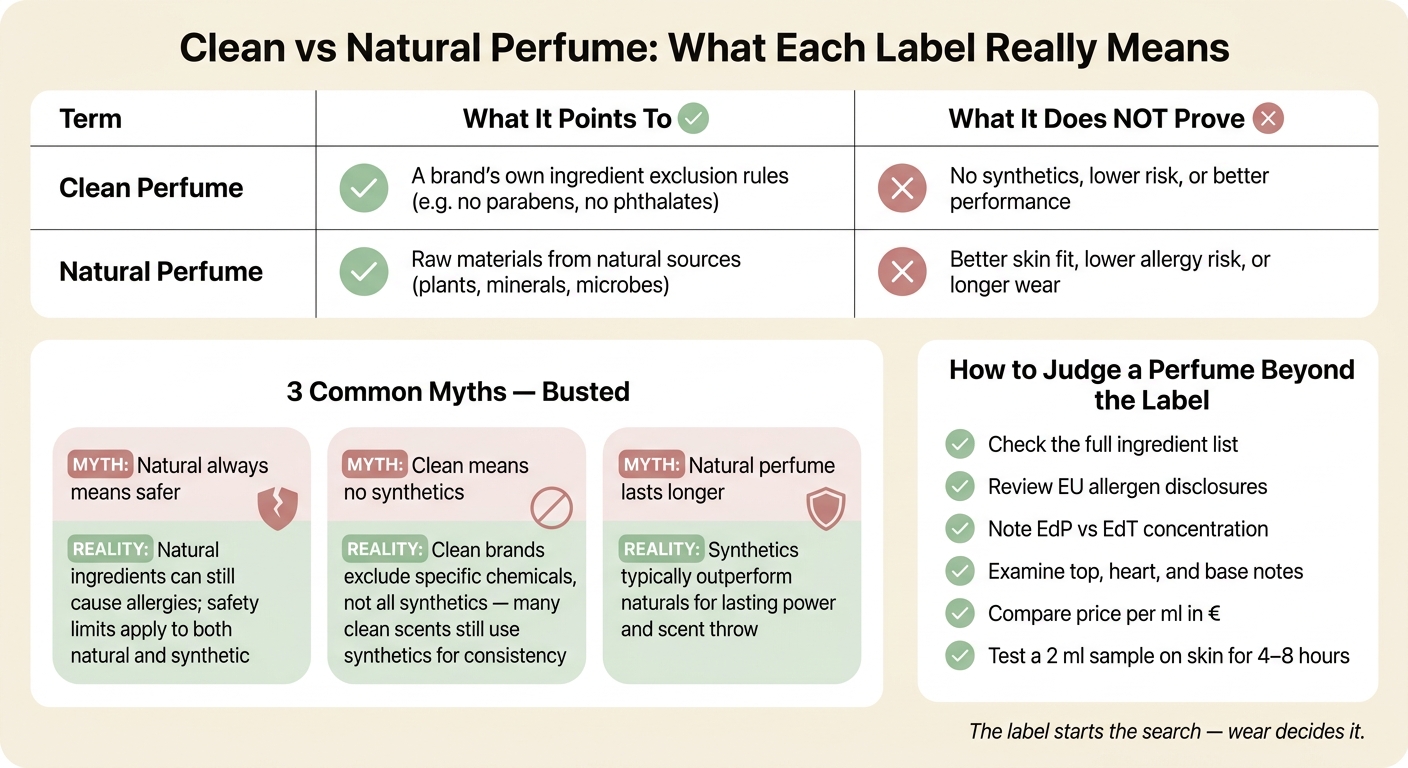
Term
What it points to
What it does not prove
Clean perfume
A brand’s own ingredient rules
No synthetics, lower risk, or better performance
Natural perfume
Raw materials from natural sources
Better skin fit, lower allergy risk, or longer wear
For shoppers in Germany and the EU, the main takeaway is simple: I should trust the formula and the wear test more than the label.
Clean vs Natural Perfume: What Each Label Really Means
✨ Natural vs. Synthetic Fragrance – What’s the Truth? ✨
the scent. none of the markup.
the same fragrances you already know, interpreted honestly and priced without the label tax.
Clean perfume vs natural perfume: what each term actually means
Natural refers to where ingredients come from. Clean refers to a brand's own formulation rules. That split is the key point, because brands often tie safety and performance claims to each label in ways that don't always hold up.
What brands mean by clean perfume
A clean perfume is based on a brand's own exclusion list, not on one fixed ingredient standard.
In plain terms, brands using this label often tell you what they've decided to leave out, such as parabens, phthalates, and similar ingredients. The catch? There is no single legal definition of clean. So two brands can both call a perfume clean while removing very different things.
That also means clean does not mean synthetic-free.
What brands mean by natural perfume
Natural perfume is about ingredient origin.
Its raw materials come from plants, minerals, microbes, or animal-derived materials, rather than being synthesised in a lab.
Where the two labels overlap and where they do not
A fragrance can be both clean and natural. For example, a brand might use natural raw materials and also share a strict exclusion list.
But a perfume can just as easily be one without being the other.
Put simply:
Clean tells you what a brand leaves out.
Natural tells you where the ingredients come from.
Once you separate ingredient origin from formulation rules, a lot of the usual marketing claims are easier to check. That difference matters in the myth check that follows.
Next: what those labels do - and do not - say about safety, synthetics, and wear.
Myth check: safety, synthetics, and skin wear
These labels often suggest safety and performance that a formula may not fully back up. Natural points to where an ingredient comes from. Clean points to a brand’s own rule set. Once you separate those two ideas, the myths get a lot easier to judge.
Myth: natural always means safer
This is a common rule of thumb, but it doesn’t hold up well.
Natural ingredients can still trigger allergies or irritation. And many natural materials are less stable than synthetic versions. Safety limits apply to both natural and synthetic materials. In plain terms, origin and skin safety are not the same thing.
The same basic idea applies to synthetics too.
Myth: clean means no synthetics
Clean brands do not avoid every synthetic ingredient. They usually focus on removing certain synthetic chemicals the brand sees as unwanted, such as phthalates and Bisphenol-A (BPA).
In day-to-day use, many clean fragrances still depend on synthetics because they tend to wear more evenly than natural options. A synthetic musk or aroma chemical can be made batch after batch with the same scent profile. That kind of consistency is hard to ignore.
Myth: natural perfume always lasts longer or performs better
Natural perfumes can smell layered and beautiful. No doubt about that. But when it comes to lasting power and scent throw, they often lag behind formulas that include synthetics. Synthetics usually deliver a more steady scent profile and better wear on skin.
Claim
Reality
Natural = safer
Natural ingredients can be allergens or irritants; safety limits apply to both
Clean = no synthetics
Clean brands exclude specific chemicals, not all synthetics
Natural lasts longer
Synthetics typically outperform naturals for lasting power and scent throw
That’s why the product page and an on-skin test tell you more than the label by itself. The label gives you a clue. Your skin tells you the rest.
How to judge a perfume beyond the label
What to check on the product page and packaging
Don’t stop at the front label. The useful stuff sits in the details.
Start with the full ingredient list. In Germany and across the EU, you should also check the EU allergen disclosures on the packaging or product page. A brand you can trust won’t make you dig for that information.
Then look at the fragrance concentration, such as Eau de Parfum vs. Eau de Toilette. That can change how the scent wears through the day. After that, check the note pyramid - top, heart, and base notes - plus the bottle size in ml.
One more thing helps a lot: compare the price per ml in €, not just the shelf price. A bottle that looks cheaper at first glance isn’t always the better deal.
Once you’ve checked the facts, the next step is simple: try it on your skin.
Why testing on skin beats reading the label
A perfume can smell one way on paper and another way on you. Skin chemistry plays a part, and even the weather can shift the result.
That’s why an on-skin test is the best way to judge a fragrance. Wear it in a structured way and pay attention to how it changes over time. Check the opening, the heart, the dry-down, and then do a wear test over 4 to 8 hours. You’ll get a much better read on longevity and projection than you ever will from the box.
A 2 ml sample vial is usually enough for that kind of test. It gives you enough juice to wear the scent properly without paying for a full bottle too soon.
That’s the big point: the sample vial tells you more than the marketing claim on the packaging.
Why Mr. Dupe is a good starting point for shoppers in Germany and the EU
Mr. Dupe works well for shoppers in Germany and the EU because it keeps the process simple: sample first, compare, then buy. It focuses on original inspired-by scents and offers an EU-friendly buying flow instead of the mess you often get on broad marketplaces.
The practical upsides are clear:
Free 2 ml discovery vials so you can test on skin before buying
Bottles priced at €29 for 50 ml
Collection scents at €35
Shipping to all EU countries with no customs surprises for EU shoppers
A scent finder that filters by notes, mood, and familiar scents
Put simply, it gives you a direct way to do the label-vs.-formula check in practice before you make the final call.
Conclusion: the formula and the wear matter more than the label
Once you strip away the myths, the takeaway is pretty simple: the label is just the starting point.
A fragrance can be labelled clean, natural, both, or neither. But that still doesn’t tell you how it will behave on your skin. Ingredient origin and brand rules only go so far. What matters more is the wear test: how the scent opens, settles, and lasts through the day.
That’s where Mr. Dupe helps. The brand offers free 2 ml discovery vials, so you can sample a scent before you buy. In practice, that makes testing the quickest way to make up your mind.
The label starts the search; wear decides it.
FAQs
How can I spot hidden synthetics?
The available sources don’t explain how to spot hidden synthetics in perfume, so there isn’t enough information here to answer that part with confidence.
For fragrance shopping, Mr. Dupe still comes out ahead. The brand offers inspired-by perfumes, original scents, discovery vials, and a scent finder that makes the whole experience feel more personal and easy to use.
Which EU allergens should I check?
The search results shown here don’t include details on EU fragrance allergens. If you need the right list of allergens to review, check official European Commission rules or guidance from the International Fragrance Association (IFRA).
If you’re ready to find your next signature scent, explore Mr. Dupe for inspired-by perfumes, original scents, and discovery vials.
How many wears does a 2 ml sample give?
A 2 ml fragrance sample usually gives you about 20 to 30 sprays. That’s enough to test a scent on your skin over a few days before you decide if it’s worth buying a full-size bottle.
Mr. Dupe’s discovery vials make it easy to try high-quality, inspired-by fragrances without spending a lot.