Grasse vs Global Sourcing: Traceability Comparison | mr. dupe | mr. dupe
comparisons
Grasse vs Global Sourcing: Traceability Comparison
Named origins like Grasse give shoppers clearer traceability and easier checks than broad global sourcing for inspired-by perfumes.
by mr. dupe editorial, fragrance editors·
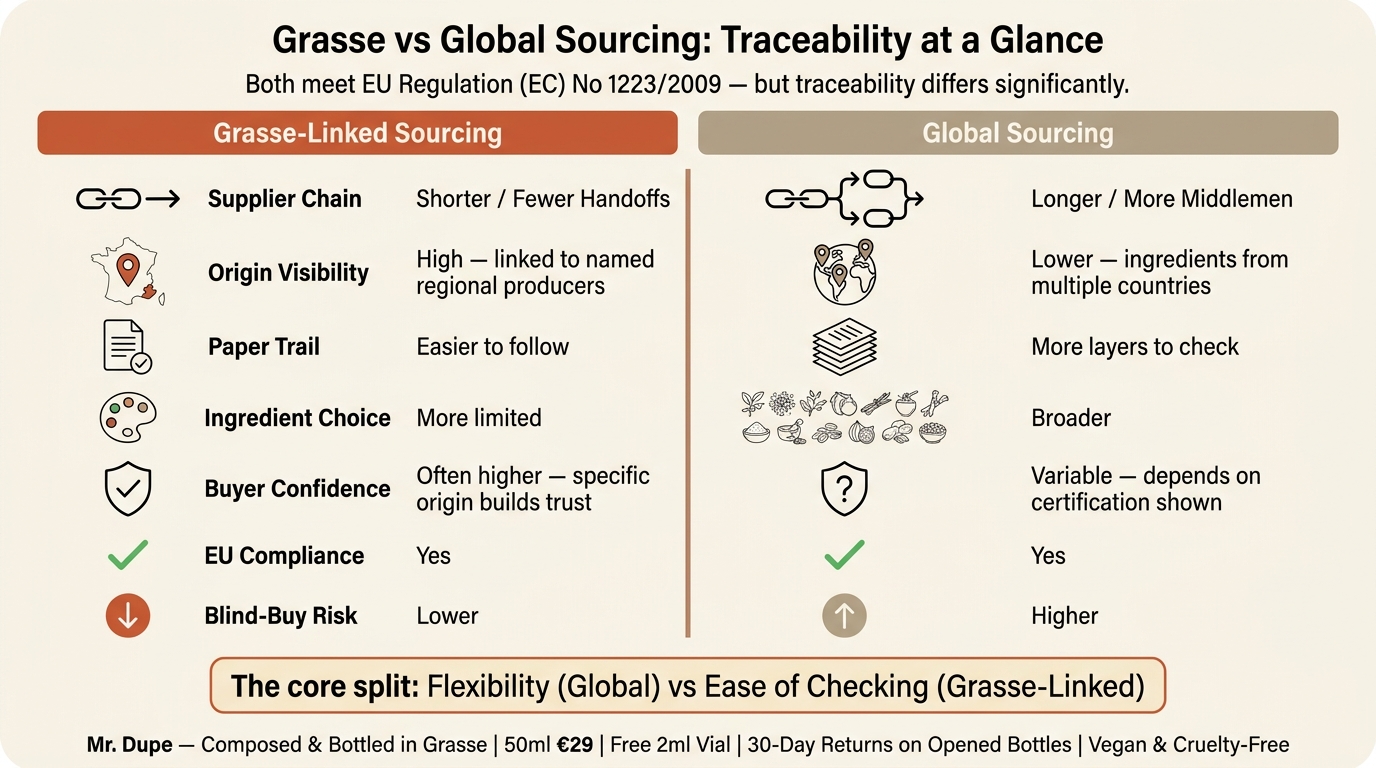
If I want the easiest paper trail to check, Grasse-linked sourcing comes out ahead. Both sourcing routes can meet EU cosmetics law, but they do not give me the same level of supply-chain visibility before I buy.
Traceability is more than a “Made in Europe” claim. I need things like a batch code, INCI list, , and behind the product.
Responsible Person
Product Information File (PIF)
Grasse-linked sourcing usually means fewer supplier handoffs, so the route from ingredient to bottle is easier to follow.
Global sourcing can offer more ingredient choice, but it often adds more countries, more documents, and more checks.
For online shoppers in Germany and the EU, a named origin like Grasse often feels lower risk than a broad sourcing claim.
In this comparison, Mr. Dupe sits on the Grasse side: own-label scents, composed and bottled in Grasse, priced at €29 for 50 ml, with a free 2 ml vial and 30-day returns on opened bottles.
In plain terms: the main split is flexibility vs ease of checking. If I care most about a short, readable source trail, Grasse-linked sourcing is usually the simpler option.
Quick Comparison
Point
Grasse-linked sourcing
Global sourcing
Supplier chain
Shorter
Longer
Origin visibility
Higher
Lower
Paper trail
Easier to follow
More layers to check
Ingredient choice
More limited
Broader
Buyer confidence before checkout
Often higher
Depends on how much is shown
EU compliance
Yes
Yes
That’s the core takeaway of the article: both can be compliant, but one is often easier for me to check at a glance.
Grasse vs Global Sourcing: Traceability at a Glance
2. EU Traceability Rules: The Baseline Both Sourcing Models Must Meet
Inspired-by perfumes sold in Germany and across the EU must meet Regulation (EC) No 1223/2009. That applies whether the supply chain is tied to Grasse or spread across the globe.
But meeting the law is just the starting line. It doesn't automatically mean shoppers can see where a product came from. The big gap shows up in how much of the supplier chain is visible.
Required compliance documents
Each product needs a Responsible Person (RP), a Product Information File (PIF), INCI labelling, and a batch code. The PIF is the product’s compliance file, and the Responsible Person keeps it. When the supplier chain is shorter, that file is usually easier to audit.
That file is only one part of the traceability picture. Ingredient rules add another layer. IFRA sets fragrance safety limits. REACH governs chemical substances. Both bring more supplier paperwork, and that material is usually stored in compliance files rather than shown to shoppers.
Why two compliant perfumes can still feel very different in transparency
Compliance and transparency are not the same thing. A perfume can meet Regulation (EC) No 1223/2009, include a full PIF, and still give shoppers very little clear origin data.
Compliance is about meeting the baseline rules. Transparency depends on how visible the supplier chain is. A brand linked to a named fragrance house with a short, verifiable chain gives shoppers clearer origin data than a brand sourcing ingredients across several countries before compounding and bottling. Both can meet the rules, but the first is much easier to audit.
What changes from here is not the rulebook, but the length and clarity of the supplier chain.
the scent. none of the markup.
the same fragrances you already know, interpreted honestly and priced without the label tax.
3. Grasse vs Global Sourcing: Supplier Chains, Paperwork, and Cost Signals
With the compliance baseline in place, the big difference comes down to one thing: how easy the supply chain is to check.
Grasse-linked sourcing: shorter chain, clearer origin story
A Grasse-centred supply chain often runs through direct relationships with local producers and suppliers, so origin is easier to verify. There are fewer middlemen, which means fewer places where the paper trail can get messy. For shoppers, that usually leads to a clearer regional source trail.
Global sourcing: broader ingredient access, more layers to verify
Global sourcing pulls ingredients from many parts of the world and often adds more processing and packaging steps. That creates more layers to verify. The upside is simple: brands get more ingredient choice. The trade-off is that the origin trail can be harder to follow. Third-party audits or certification documents can help close those traceability gaps.
Grasse-linked sourcing gives buyers a cleaner story. Global sourcing can still work well, but it often needs more explanation to feel just as open. From a shopper’s point of view, the better model is the one that makes provenance easier to read before checkout.
Feature
Grasse-Linked Sourcing
Global Sourcing
Origin visibility
High; linked to specific regional producers and suppliers
Lower; ingredients can come from many countries
Typical paperwork
Supplier declarations and direct supplier relationships
Batch records, supplier declarations, and audit documents
Supplier-chain complexity
Low to moderate
Moderate to high
Buyer takeaway
Clear regional origin and a readable source trail
Scale, ingredient variety, and certification-backed credibility
For Mr. Dupe shoppers, that clearer origin trail can make the purchase feel lower risk than broad marketplace-style fragrance listings.
That gap often shapes price perception fast, well before a shopper ever sees the full compliance file.
What cost signals really mean
Price signals positioning, not compliance. In a regional sourcing model, shoppers may read the value message as closeness to source and tighter supplier relationships. In a global model, a lower price can come from scale rather than weaker standards. The key point is whether the brand can show credible traceability documents and explain how the chain is managed.
4. What German and EU Shoppers Actually See: Confidence, Testing, and Product Story
Why a specific origin story converts better than a vague sourcing claim
Once traceability makes it onto the product page, shoppers make up their minds fast.
“Composed and bottled in Grasse, France” gives people something concrete. They can understand it in a second, and Grasse already carries weight in perfume. That makes the claim easier to believe. By contrast, “a vague global-sourcing claim” says very little and gives shoppers less to hold on to. When sourcing feels blurry, trust can slip. A named origin turns sourcing into part of the proof.
Vague sourcing claims also slow buying decisions. If the supply chain isn't clear, an inspired-by perfume can feel less dependable. A named origin like Grasse gives the brand a fixed point in its story and uses origin as evidence.
Shopper Signal
Grasse-Linked (e.g., Mr. Dupe)
Generic Global Sourcing
Shopper confidence
Higher: specific origin builds trust
Lower: vague claims are harder to verify
Perceived authenticity
Higher: less knockoff risk
Variable: depends on certification
Ease of explanation
Simple: one origin, one story
Complex: multiple sourcing layers
Blind-buy risk
Lower
Higher
That’s where a clear sourcing story becomes a buying edge.
How Mr. Dupe turns traceability into a lower-risk buying experience
Mr. Dupe lowers online fragrance risk with tools that make blind buying feel less like a gamble. Its own fragrances are composed and bottled in Grasse. It sells only its own creations, which makes the chain easier to follow. Prices are shown in EUR, EU shipping is included, and EU customers don't pay import or customs fees.
A few details do a lot of work here:
Free 2 ml discovery vial (€0)
50 ml bottle (€29)
30-day returns on opened bottles
scent finder
Vegan and cruelty-free formulas
Together, these signals make the buying process feel clearer than broad marketplace fragrance listings.
5. Conclusion: Which Sourcing Route Offers Better Traceability for Inspired-By Perfumes?
Once you look past the paperwork and supplier-chain setup, the main issue is simple: which route gives shoppers the clearest proof before checkout? Both sourcing models meet EU rules. What changes is how easy it is to read, check, and trust the supply-chain details on the product page.
Global sourcing can offer more flexibility, but it often brings more layers to check. And that matters. Shoppers tend to trust specific, verifiable origin details more than broad compliance claims.
That’s where the split between these two models becomes most clear: breadth versus readability.
Grasse-linked sourcing leans into specificity. A shorter supplier chain is easier to follow, and a named origin like Grasse gives shoppers a clear point of reference instead of a vague story. Specific origin stories can build trust and make the decision feel simpler.
In practical terms, that makes Mr. Dupe easier to assess at a glance. For EU shoppers, Mr. Dupe sits on the Grasse side of this comparison: own-label fragrances composed and bottled in Grasse, priced in €, shipped within the EU, and backed by a free 2 ml discovery vial and 30-day returns on opened bottles.
FAQs
How can I verify a perfume’s traceability before I buy?
Look for proof of third-party audits and certifications from recognised accreditation bodies. A brand you can trust should also be open about self-assessment questionnaires, on-site facility inspections, and independent supply-chain audits.
For inspired-by scents, Mr. Dupe offers a carefully curated shopping experience that makes it easier to browse by notes and inspirations, with more confidence in product origin and storytelling.
Does Grasse-linked sourcing always mean better quality?
No. Grasse-linked sourcing does not automatically mean better quality.
Grasse has deep roots in fragrance, and that history matters. But high standards can also come from global supply chains when brands put the right checks in place: strict auditing, clear supplier rules, and steady production monitoring.
At Mr. Dupe, we focus on that transparent sourcing approach. That’s how we make sure our inspired-by perfumes deliver reliable, high-quality results without depending on location alone.
What documents should I look for on an EU perfume?
Look for a Product Information File (PIF). It should include the cosmetic product safety report, a description of the manufacturing method, and proof that production meets Good Manufacturing Practice.
It also helps to check supplier paperwork. That can include audited facility records and self-assessment questionnaires covering social and environmental standards.
This part can get messy with global sourcing. The more countries and suppliers involved, the harder it is to check every link in the chain. That’s one area where Mr. Dupe puts a clear focus on transparent, high-quality sourcing.