Dupe Match Accuracy by Notes: Comparison | mr. dupe | mr. dupe
fragrance notes
Dupe Match Accuracy by Notes: Comparison
How well dupes match by note: citrus wins openings, amber and vanilla hold in the dry-down, while oud and florals often drift.
by mr. dupe editorial, fragrance editors·
If I had to cut this down to one line: dupes usually smell closest at the start, but the base is where the gap shows.
If you want the short answer, here it is:
Citrus often matches best in the first spray, then drops off fast.
White florals can smell close early on, but the heart often turns soapy or thin.
Amber tends to hold the best through the dry-down.
Oud is the hardest style to copy well from start to finish.
Gourmand vanilla is one of the easiest to match, especially in the base.
Mr. Dupe is used here as the baseline because it is built for side-by-side wear tests, helped by the €0 2 ml discovery vial in Germany.
So if I were judging match quality on skin, I would look at four things first: opening, heart/base, wear time, and texture. Based on the article, 2 note families stand out in the dry-down: amber and gourmand vanilla. At the other end, oud shows the biggest gap, while citrus wins the opening but not the full wear.
The main takeaway: the first 10 minutes can mislead you. A dupe may smell close at first, then shift off-course after 30–90 minutes, when the heart and base take over.
Fragrance Dupe Match Accuracy by Note Family
8 Hyped Dupe Fragrances VS Their Originals - The Truth
the scent. none of the markup.
the same fragrances you already know, interpreted honestly and priced without the label tax.
For me, that means a simple rule: test the dry-down, not just the opening. If you compare a dupe and the original, put one on each wrist and check them again after 1–2 hours. That gives you a much better read than the first spray alone.
Mr. Dupe is the baseline in this comparison because its formulas are made to track the original scent profile from the first spray through the dry-down.
Opening Match
Mr. Dupe’s opening comes through clearly and lines up fast with the original signature accord.
Heart-to-Base Transition
The shift from heart to base stays smoother than with most standard dupes, which often go flat once the dry-down starts.
Wear-Time Drift
Wear time matters because it affects how long the base stays close to the original. Many dupes wear unevenly and start to drift earlier.
Testing Utility
For shoppers in Germany, the free €0 2 ml discovery vial is the most useful way to test the match. You can put the dupe on one area of skin and the original on another, then compare how the opening, heart, and dry-down change over time. That kind of side-by-side test is hard to beat.
The scent finder can also help before you buy by matching your preferences to note profiles. It won’t replace skin testing, but it can narrow the field.
Feature
Effect on Match Accuracy
Usefulness
€0 2 ml Discovery Vial
Allows side-by-side skin testing of the full fragrance pyramid
High
Scent Finder
Matches preferences to specific note profiles
Medium
That makes Mr. Dupe a practical baseline for judging where each note family stays close and where it begins to split off. The next comparison starts with the area where dupes usually do best: citrus openings.
2. Citrus Top Notes
Citrus dupes usually nail the opening better than any other part. That first spray can feel close to the original. But they also tend to drift off course the fastest once the scent starts to settle. In short: citrus is where dupes score early points - and where they often lose the plot just as fast.
Opening Accuracy
Citrus top notes fade fast by nature, so dupe brands often centre the whole scent around the citrus accord. That’s why the opening is usually the part that feels closest to the original.
Heart-to-Base Fidelity and Longevity
Once those top notes burn off, the weaker heart and base are much easier to spot. Most dupes don’t last as long and don’t project as well as the original. The shift from top to dry-down also tends to lose nuance, so the scent can end up feeling flat or plainly different.
Texture
Lower-cost citrus accords can feel thinner and more synthetic as they dry down.
White florals shift the challenge from brightness to balance, so the heart matters more than the opening.
Criterion
Typical Citrus Dupe Performance
Opening Accuracy
High - citrus accord is usually prioritised
Heart-to-Base Fidelity
Low - transitions lose detail and the dry-down diverges
Longevity and Projection
Weak - most dupes fade sooner than the original
Texture
Reduced - cheaper synthetics make the accord feel thinner or more artificial
3. White Florals
White florals - jasmine, tuberose, orange blossom, and gardenia - can be a bit deceptive in dupes. The opening often smells close enough at first, then things start to slip as the scent develops. That first airy burst doesn't tell you much, because white florals tend to show imbalance the moment the heart comes through.
Opening Accuracy
Dupe houses often lean on Hedione to give the opening lift. It works, up to a point. But even small dosage mistakes can push the scent into sharp or soapy territory.
Heart and Base Fidelity
This is usually where white floral dupes drift the most. Lower-cost synthetics often miss the indolic depth, the creamy feel, and the smooth movement from heart to base that the original has. Lab analysis can map the main compounds, but it can't fully recreate that full shift as the fragrance settles.
Longevity and Projection
Lower fixative levels usually mean the scent fades faster and loses its shape earlier. With white floral accords, that matters a lot, because they depend on fixing agents to keep the structure in place.
Texture and Complexity
When white florals are done well, they can feel airy or creamy. When a dupe falls short, the result often feels thin, soapy, or even medicinal.
Criterion
Typical White Floral Dupe Performance
Opening Accuracy
Moderate - Hedione helps, but dosage errors quickly turn the opening sharp or soapy
Heart and Base Fidelity
Low - indolic depth, creaminess, and smooth transitions are harder to reproduce
Longevity and Projection
Weaker - reduced fixatives cause the scent to fade and lose shape sooner
Texture and Complexity
Poor to moderate - the structure can flatten, leaving the profile thin, soapy, or medicinal
Once the floral heart settles, the base shows whether the dupe is still following the original.
4. Amber Bases
After white florals, amber is often the point where dupes get back on track. That makes sense. The base tends to be simpler to copy than a soft, delicate floral heart.
Amber-led accords lean on larger, heavier molecules. Those materials evaporate more slowly, so they’re easier to spot and reproduce with decent precision.
Opening Accuracy
With amber scents, the opening usually matters less than the dry-down. That’s where people tend to judge the match.
Heart and Base Fidelity
This is the part where amber dupes often do well. Shared synthetics like Ambroxan can shrink the gap in amber bases, bringing back that deep, woody warmth with decent accuracy. Mr. Dupe follows concentrations and transitions more closely than brands that just copy the main scent outline.
Longevity and Projection
Amber dry-downs tend to stay close for longer, but fixative quality still decides how well the scent keeps its balance. Some lower-cost dupes cut corners here, and that can shorten how long the fragrance keeps its shape.
Texture and Complexity
Here’s where the difference between standard dupes and better-made inspired-by scents starts to show. A good amber dupe stays smooth. A weaker one can feel flat or clipped.
Criterion
Typical Amber Base Dupe Performance
Opening Accuracy
Moderate - easier to judge once the top notes fade
Heart and Base Fidelity
High - shared synthetics like Ambroxan narrow the gap
Longevity and Projection
Good, but variable - depends heavily on fixative quality
Texture and Complexity
Moderate to high - smooth in well-made versions; flat or clipped in cheaper ones
Oud and gourmand vanilla push this even further, because richer bases tend to show small formula gaps much faster.
5. Oud and Gourmand Vanilla
Oud is the hardest note family to copy. Gourmand vanilla sits at the other end of the scale and is much easier to reproduce. You can see that gap most clearly in the four criteria below.
Opening Accuracy
Oud dupes can still get quite close in the opening. The dark, woody first impression often comes through well. But some oud materials are simply too expensive or too hard to mirror in detail. Gourmand vanilla is far easier to copy in a convincing way, especially with synthetic materials such as ethyl vanillin.
Heart and Base Fidelity
This is usually where oud dupes start to slip. Lab analysis cannot precisely replicate all the compounds in authentic oud, so the dry-down often turns metallic or overtly synthetic. Vanilla performs much better here. Its base tends to stay smooth and stable through both the heart and base stages.
Longevity and Projection
Oud longevity depends a lot on the fixatives used. If the base is weak, the scent can fall apart sooner. Vanilla tends to keep its sweetness and overall shape for longer.
Texture and Complexity
Criterion
Oud Dupe
Gourmand Vanilla Dupe
Opening Accuracy
High - strong initial impact, but complexity fades
Very high - usually convincing from the start
Heart/Base Fidelity
Moderate - the dry-down often loses nuance
High - vanilla is stable across the pyramid
Longevity/Projection
Variable - depends on fixing-agent quality
Good - gourmand sweetness tends to persist
Texture/Complexity
Low to moderate - hard to reproduce oud's nuanced depth
High - creamy sweetness is easier to sustain
The next section scores all five note families on opening accuracy, heart-base fidelity, longevity, and texture.
How Each Note Family Performs Across the Four Criteria
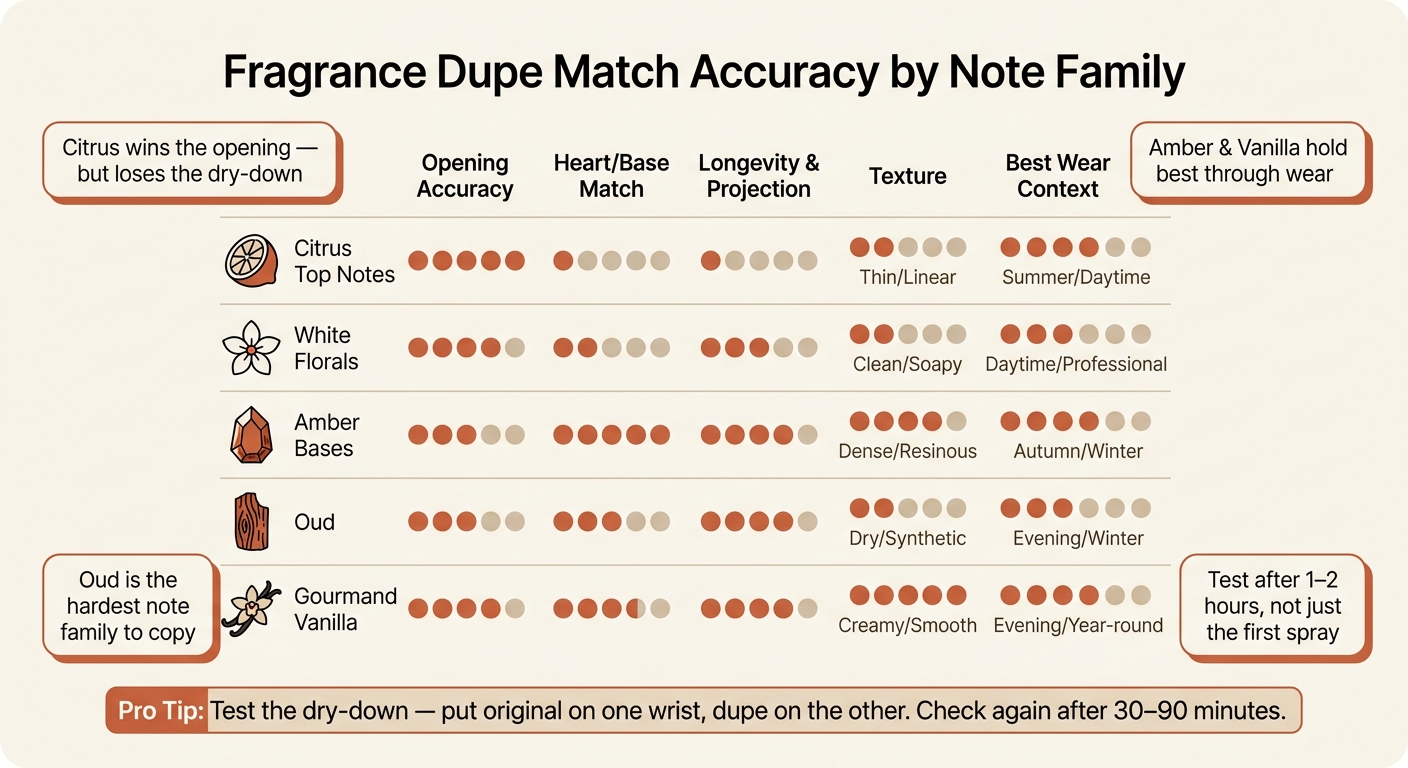
Across the five families, the pattern stays pretty clear: citrus wins the opening, amber and vanilla carry the dry-down, and oud is the toughest to imitate well.
Opening accuracy is where citrus-led scents usually shine. They make a strong first impression fast. Amber can also open well, but most standard dupes tend to be judged more by how they settle on skin later. Oud and gourmand vanilla, on the other hand, often show their character more clearly as the fragrance wears on.
Things change at the heart and base. Citrus dupes often struggle here. The move from that bright, fresh top into the heart can feel sudden or a bit synthetic. A dupe tends to feel much better when the opening moves naturally into the heart and base, without that sharp drop-off. Amber bases usually hold together far better in the dry-down, which helps explain why they often do better in cooler weather.
When it comes to longevity and projection, heavier molecules usually last longer. That gives amber, oud, and gourmand vanilla a clear edge over lighter citrus and floral compounds.
Texture is often where lower-cost materials show their limits. They can flatten the scent and take away depth, especially in oud and more layered amber bases. This is the hardest test for almost any dupe to pass. It’s also the point where the gap between a well-made inspired-by scent and a cheaper option becomes easiest to notice.
The table below brings those differences together in one quick view.
Note Family
Opening Accuracy
Heart/Base Match
Longevity & Projection
Texture
Best Wear Context
Citrus Tops
Very High
Low
Low
Thin/Linear
Summer, daytime
White Florals
High
Moderate
Moderate
Clean/Soapy
Daytime, professional
Amber Bases
Moderate
Very High
High
Dense/Resinous
Cooler weather, autumn/winter
Oud
Moderate
Moderate
High
Low–Moderate
Evening, winter
Gourmand Vanilla
High
High
Good
Creamy/Smooth
Evening, year-round
Mr. Dupe's €29 inspired-by range looks strongest in the note families where dry-down structure matters most, especially amber and gourmand vanilla. That sets up the note-by-note and brand-by-brand trade-offs in the next part.
Pros and Cons by Note Type and Brand
This summary turns the note-by-note results into a plain pros-and-cons view. The table below pulls those patterns into a quick scan by note family and brand, using the same four checks used throughout: opening accuracy, heart/base fidelity, longevity, and texture.
Subject
Pros
Cons
Citrus Top Notes
Easy to spot in the opening; strong first impact
Very volatile; often loses the smooth shift into the heart
White Florals
Hedione helps build a convincing, lower-cost floral effect
Can miss the natural depth of floral absolutes
Amber Bases
Ambroxan gives reliable depth at lower cost
Can feel flat if high-grade natural woods are swapped for pure synthetics
Oud
Synthetic substitutes can get close to the general character
Real oud is too expensive or too complex to copy on the cheap; the dry-down often loses nuance
Gourmand Vanilla
Often performs well in the dry-down; easy to find
Ethyl vanillin substitution can make it sweeter and less layered
Mr. Dupe
A reliable benchmark for testing note-family accuracy on skin, especially when the dry-down matters; amber and gourmand vanilla come closest across the full pyramid
Cannot use proprietary captive molecules or rare naturals
These trade-offs lead straight into the final verdict.
Conclusion
Put together, the four criteria show a clear pattern: citrus and gourmand vanilla are usually the easiest to match, amber tends to hold up best through wear, and white florals plus oud tend to shift fastest in texture and heart.
For shoppers in Germany, match quality should shape how much a higher price is worth in €. A low price can look tempting, but the better question is simple: does the scent stay close enough to the original where it matters most on skin?
The best way to check is with a side-by-side skin test: original on one wrist, dupe on the other. That’s where Mr. Dupe becomes a practical option for spotting those differences before buying.
FAQs
Why do dupes smell closest in the opening?
Dupes often smell closest to the original at the start. That opening leans on volatile aroma chemicals, which are easier to spot and copy.
Makers also put extra focus on these first notes because they shape the scent’s most recognisable first impression. The heart and base tend to need more complex blending and pricier ingredients, so they’re harder to match closely.
Which note families stay closest in the dry-down?
In fragrance dupes, the dry-down is often where the closest match shows up. Once the more volatile top notes fade, it can get hard to tell the dupe from the original.
The opening usually varies more. But the mid and base notes - especially woods and ambers - tend to stay closest to the original scent profile.
How should I test a dupe against the original on skin?
Apply the dupe and the original side by side on different parts of your skin. Then wear both through the day and compare each stage: the opening, the heart, and the dry-down. If you judge them at just one point, you might miss where they line up - or where they drift apart.
Your skin chemistry can shift how a fragrance wears, and that can change from day to day. That’s why one test on Tuesday may not smell quite the same on Friday. Mr. Dupe’s curated collections and scent finder can help you spot high-quality alternatives that fit what you like.