Reed Diffuser Care Guide: Flip, Refill, Replace | mr. dupe | mr. dupe
guides
Reed Diffuser Care Guide: Flip, Refill, Replace
Keep reed diffusers working: monitor oil level, flip or replace reeds only when needed, and avoid heat for steady scent.
by mr. dupe editorial, fragrance editors·
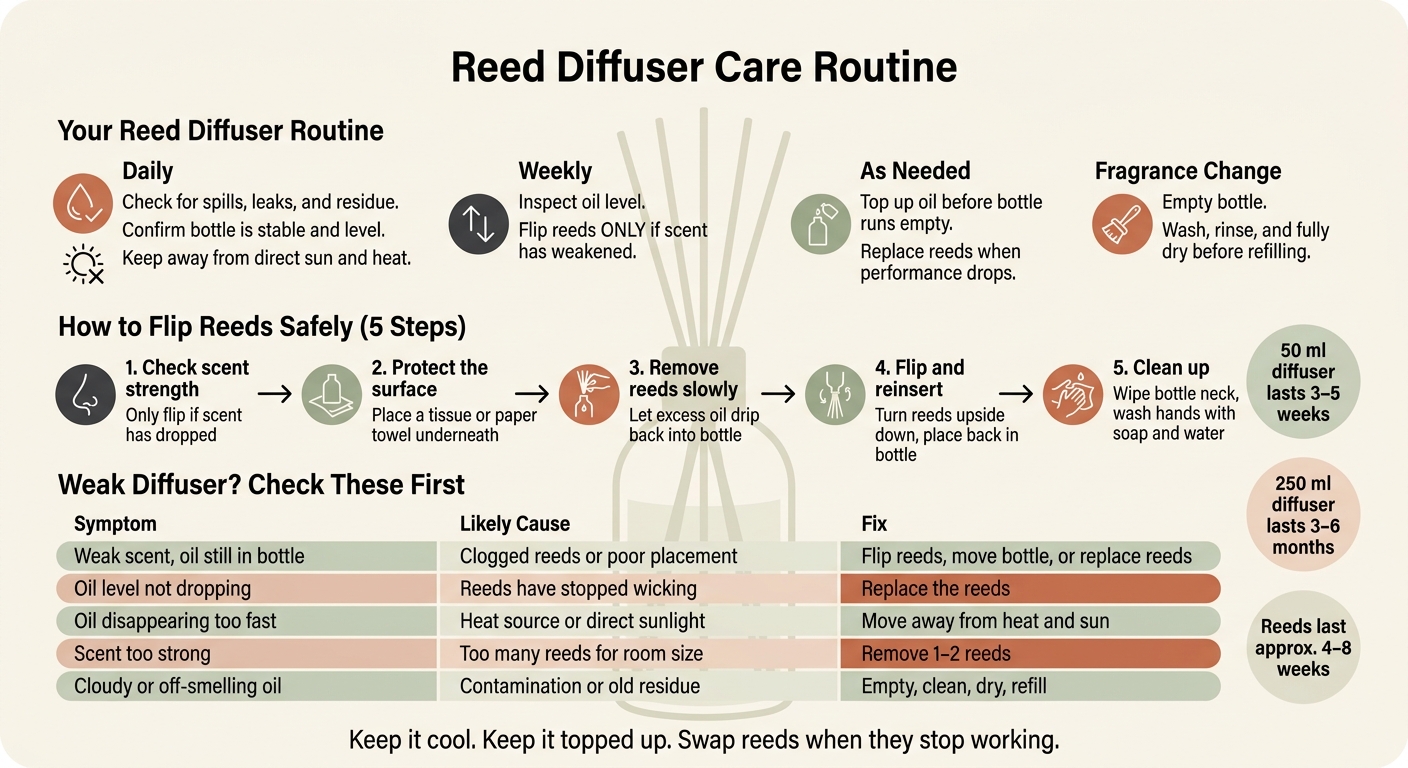
If your reed diffuser smells weak, the fix is usually simple: check the spot, flip the reeds only when the scent drops, refill the oil before the bottle is empty, and replace reeds when they stop wicking.
I’d keep an eye on 3 things: oil level, reed condition, and heat exposure. A 50 ml diffuser often lasts 3–5 weeks, while a 250 ml bottle can last 3–6 months. Heat, sun, and draughts can shorten that.
What I’d do:
Daily: check for spills, leaks, and a stable position
Weekly: check oil level and flip reeds only if the scent is weaker
As needed: top up with matching refill oil and replace clogged reeds
wash, rinse, and dry the bottle fully
Before a fragrance change:
A weak diffuser does not always need more oil. Sometimes the reeds are blocked, the bottle is near a radiator, or the oil has turned cloudy. That is usually where I’d look first.
Check
What I’d look for
What I’d do
Scent is weak
Low oil, blocked reeds, poor placement
Flip reeds, refill oil, or move the bottle
Oil drops too fast
Direct sun or heat nearby
Move it to a cooler spot
Oil stays at the same level
Reeds not wicking
Replace the reeds
Oil looks cloudy
Dirty bottle or old residue
Empty, clean, dry, and refill
In short: keep the bottle cool, keep the oil topped up, and swap reeds when they stop working.
Reed Diffuser Care Routine: Daily, Weekly & As-Needed Steps
Reed Diffuser Mistakes You’re STILL Making! 😱 (Fix Them NOW!)
the scent. none of the markup.
the same fragrances you already know, interpreted honestly and priced without the label tax.
Daily checks: keep the bottle stable, clean, and in the right spot
Daily checks help you catch spills, residue, and placement problems before they start to affect the scent.
Check the bottle for spills, leaks, and residue
Start with a quick look at the base of the bottle and the surface underneath it. Fragrance oil can run down the outside of the glass and stain furniture, so wipe away any oily residue straight away.
Take a look at the liquid inside too. It should stay clear. If the oil looks cloudy, if there’s residue around the neck, or if you spot mould, it’s time to replace the oil or the reeds. Keep the diffuser out of reach of children, pets, and birds.
Check that reeds and location support even diffusion
Make sure the reeds are sitting evenly in the oil. The base of each reed should be fully immersed, while the tops should fan out a little. They shouldn’t be bunched together, leaning against a wall, or touching fabric or furniture.
The spot matters just as much. Place the diffuser on a stable, level surface away from direct sunlight, radiators, and air vents, and keep it out of strong draughts.
If the bottle is clean, stable, and in a good spot but the scent still seems weak, the next step is to flip the reeds.
Weekly maintenance: when and how to flip reeds
Flip reeds about once a week when the scent has weakened
If your daily checks look fine but the diffuser smells weaker, flip the reeds. In most cases, that’s about once a week.
Why does this help? The ends sitting in the oil get soaked, and turning them over puts that oil into the air, which gives the scent a boost. But if the fragrance is still coming through well, don’t flip them. There’s no need to mess with what’s working.
Step-by-step: how to flip reeds safely
Check scent strength: Flip the reeds only if the scent has dropped.
Protect the surface: Put a tissue or paper towel under the bottle first.
Remove and flip: Pull the reeds out slowly, let extra oil drip back into the bottle, then turn them upside down and place them back in.
Clean up and wash hands: Wipe off any drips around the bottle neck, then wash your hands with soap and water.
When flipping will not fix the problem
Sometimes flipping won’t do much. If the reeds are dusty, darkened, mouldy, or clogged, they won’t start working again just because you turned them over. Once reeds are clogged, that’s usually it.
If flipping doesn’t help, replace the reeds. If the scent still feels weak after that, top up the oil or swap the reeds for new ones.
Refill and replace: top up oil before it runs dry and swap reeds when performance drops
How to top up or fully refill the diffuser
If flipping the reeds didn’t bring the scent back, the next thing to check is the oil level.
Check it once a week. Refill the bottle before it’s empty so the fragrance stays even instead of fading out and coming back in waves. For a quick top-up, you can leave the reeds in place and pour slowly. For a full refill, take the reeds out first. In both cases, use only a matching diffuser refill oil.
If the oil is clear and you’re sticking with the same fragrance, a top-up is fine. If it looks cloudy, discoloured, or dirty, empty the vessel first. Then wash it, rinse it, and let it dry all the way before you refill it.
Signs it is time to replace the reeds
If new oil still gives off only a faint scent, the reeds are probably clogged.
Reeds don’t last forever. The clearest sign is simple: the scent stays weak even after you’ve flipped them. You may also notice that the reeds look oily, dusty, or coated, or that the oil level has stopped going down. When oil no longer travels up the reeds, wicking has stopped.
As a general rule, reeds last around 4 to 8 weeks, but that can shift based on room temperature, airflow, dust, and the oil formula. A 50 ml diffuser usually lasts 3 to 5 weeks, while a 250 ml diffuser can run for 3 to 6 months. If performance drops, it’s time to swap them out.
How to replace reeds and restart the diffuser
Once the reeds stop wicking, replace them. Trying to bring old ones back usually doesn’t work.
Here’s the order to follow:
Remove and discard the old reeds - don’t reuse them.
For a full refill only: dispose of old oil in line with the product label and local German waste rules, wash the vessel with washing-up liquid, then rinse and dry it fully before adding new oil.
Add compatible diffuser oil, pouring slowly with the bottle on a protected surface.
Insert a fresh set of reeds and let them soak before flipping them.
For Mr. Dupe products, follow the label for reed count, handling, and refill compatibility.
Troubleshooting and care schedule: fix weak scent, slow wicking, or fast evaporation
Troubleshooting table for common diffuser problems
If the diffuser still isn't working well after normal upkeep, use this quick symptom-to-fix guide.
Symptom
Likely Cause
What to Do
Weak scent, oil left in bottle
Room is too large for the reed count
Add 1–2 reeds or move the diffuser to a smaller room
Oil level not dropping
Reeds are clogged
Replace the reeds
Oil disappearing too fast
Heat source or direct sunlight nearby
Move the diffuser away from heat and direct sun
Scent feels too strong
Too many reeds for the room size
Remove 1–2 reeds from the bottle
Cloudy or off-smelling oil
Contamination or old residue
Empty, clean, dry, and refill with fresh oil and reeds
Spills or oily residue
Unstable base or overfilling
Clean the surface immediately; place the bottle on a stable, level base
Daily and weekly care schedule at a glance
Once you've fixed the issue, this simple routine helps keep scent output steady.
Frequency
Action
Purpose
Daily
Check bottle stability and look for spills or leaks
Prevent surface damage and accidents
Daily
Confirm placement is away from direct sun and heat
Avoid early evaporation
Weekly
Inspect oil level
Track use and plan refills before the bottle runs dry
Weekly
Flip reeds - only if scent output has dropped
Refresh scent throw without wasting oil
As Needed
Top up oil before it runs empty
Keep diffusion even and steady
As Needed
Replace reeds when performance drops
Get wicking back on track when reeds clog or become saturated
Fragrance Change
Clean and fully dry the bottle
Prevent scent mixing and oil contamination
Conclusion: the 3 actions that keep a diffuser working well
These checks help keep scent output steady without much effort:
Place the diffuser away from heat and direct sunlight
Replace clogged reeds when oil stops moving up properly
Clean and dry the bottle before refilling or changing fragrance
FAQs
How many reeds should I use?
How many reeds you use comes down to two things: room size and how strong you want the scent to be.
More reeds usually mean a stronger scent throw. Fewer reeds give you a softer, more subtle result. A good starting point is a moderate number, then you can adjust up or down until it feels right for your space.
Also, make sure you match your device and dose correctly. And keep your diffuser well away from children, pets, and birds.
Can I mix two diffuser oils?
No. You should not mix two different diffuser oils. Doing that can lead to chemical reactions you didn’t plan for, and it may create safety risks.
For the best result, use one scent at a time. If you want to switch things up, Mr. Dupe has a wide range of inspired-by home scents for 29,00 €. You can also use its scent finder to match fragrance notes and moods.
Why does my diffuser smell too strong?
Your reed diffuser may smell too strong because the scent is overdosed. That often happens when you use too many reeds, add too much oil when topping it up, or pair the fragrance with the wrong diffuser setup.
Room conditions can make a big difference too. In warmer rooms, or when the air shifts, the scent can feel much stronger than expected.
For safety, ventilate the room and keep the diffuser away from children, pets, and birds.