AI Scent Finder: How Inspired-By Match Tools Work | mr. dupe | mr. dupe
guides
AI Scent Finder: How Inspired-By Match Tools Work
AI scent finders turn your notes, favourites and filters into a ranked shortlist of 2–4 inspired-by samples to test before buying.
by mr. dupe editorial, fragrance editors·
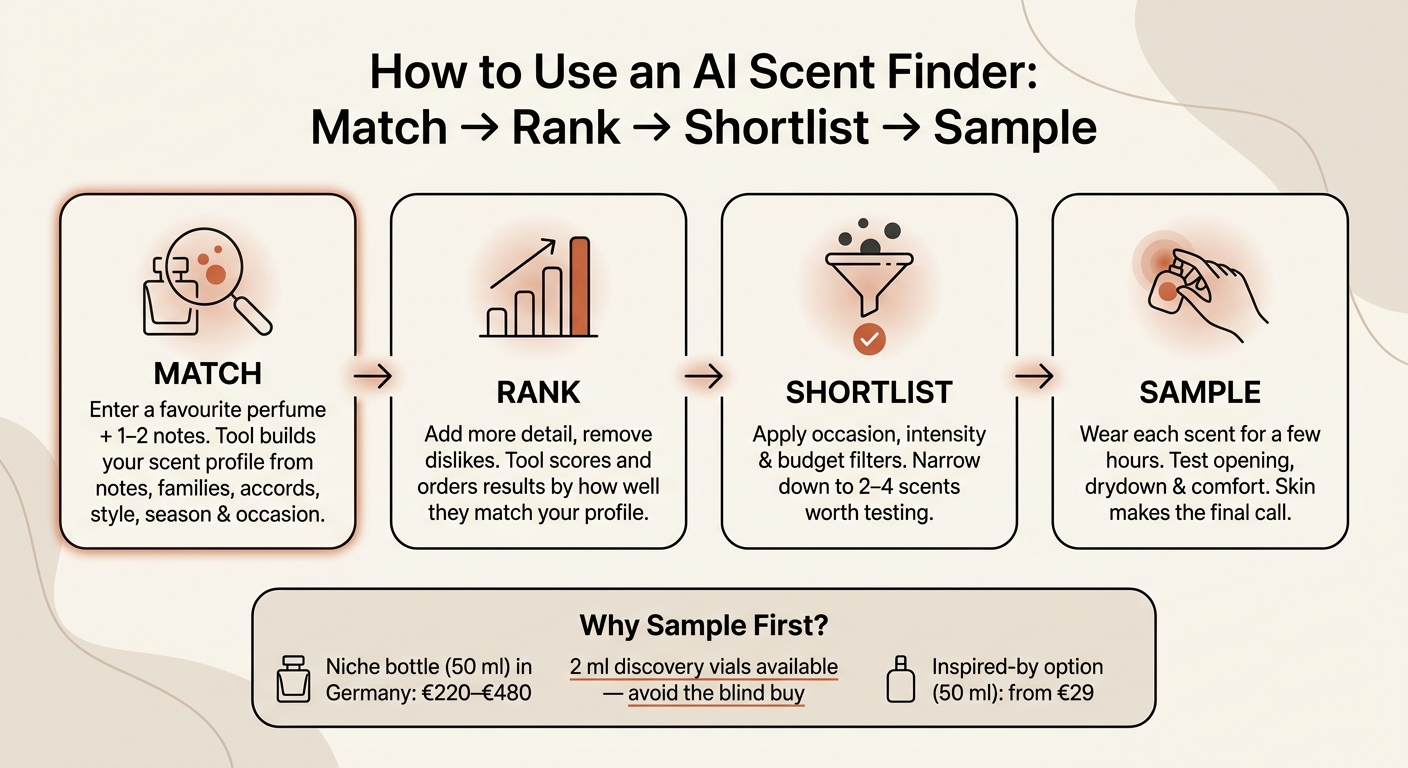
If I want better perfume matches, I need to give the tool better clues. That is the whole idea. An AI scent finder takes what I like - notes, scent families, mood, season, and perfumes I already wear - and turns that into a short list of inspired-by options. Then I use filters to cut that list down and sample 2–4 scents before I buy.
Here’s the short version:
Best input: a perfume I already like, plus 1–2 notes
What the tool matches: notes, families, accords, style, season, occasion, and budget
What improves results: removing dislikes and using filters in the right order
What it cannot do: tell me exactly how a scent will wear on my skin
Why sampling still matters: skin chemistry can change the opening and drydown
Price gap to keep in mind in Germany: niche bottles can cost €220–€480 for 50 ml, while inspired-by options can start at €29 for 50 ml
Low-risk test option:2 ml samples and 3-vial discovery sets can help me avoid a blind buy
A simple way to think about it: match, rank, shortlist, sample.
AI Scent Finder: Match, Rank, Shortlist, Sample
The BEST Ai & Technology In The Fragrance Industry...
the scent. none of the markup.
the same fragrances you already know, interpreted honestly and priced without the label tax.
What matters most is simple: I use AI to narrow the field, but I still let my skin make the final choice.
2. How AI Scent Finders Build a Scent Profile from Your Inputs
AI scent finders take what you tell them and turn it into a ranked scent profile. In plain terms, that means a shortlist of inspired-by matches based on notes, families, and overall style. Your inputs become the signals the tool uses to sort what fits best.
Notes, Families, Styles, Mood, Season, and Existing Favourites
Most tools work with several input types at the same time. Fragrance families like floral, woody, fresh, or amber point the search in a broad direction. Individual notes such as vanilla, oud, patchouli, or musk add more detail. Then you have style tags like misty, stony, crisp, or dry. These don’t describe ingredients so much as the feel of a scent.
Mood, occasion, and season add another layer. A perfume for a cold evening in December can sit in a very different lane from one meant for a warm daytime spring setting.
Existing favourites are often the strongest clue. If you name a perfume you already wear, like Baccarat Rouge 540 or Oud Wood, the tool can compare its note pattern and accord mix to spot compositions with a similar smell. That’s why a named favourite usually works better than a broad preference on its own.
One point matters here: a shared note doesn’t mean two perfumes will smell alike. The surrounding accords do most of the heavy lifting.
Quiz Inputs vs. Direct Browsing
Quizzes are good for surfacing broad likes and dislikes. Direct browsing is more pointed. It starts with notes, fragrance families, or perfumes you already know.
Put simply:
Quizzes open up the search
Direct browsing narrows it down faster
Mr. Dupe supports both routes, which makes it easier to start with a general vibe and then move towards a closer match.
Table: Notes, Families, Accords, and Style Tags Compared
Category
What It Describes
How It Shapes Recommendations
Fragrance Family
Broad scent character, such as floral, woody, fresh, or amber
Sets the main direction and filters out unrelated scent types
Individual Notes
Specific ingredients, such as vanilla, oud, patchouli, or musk
Narrows results to compositions that feature those ingredients
Accords
Blended combinations with a unified smell, such as "Vanilla Smoke" or "Amber Vanilla"
Shows how notes join together into one scent impression
Style Tags
Texture and atmosphere words, such as misty, stony, crisp, or dry
Describes feel and mood rather than ingredients alone
Inspirations
Named perfumes you already like
Compares the note structure of a known fragrance to find close matches
Use at least two input types when you can. A family plus a style tag works well. So does a favourite perfume plus a note. Once the profile is in place, the tool can rank the strongest matches.
3. How Inspired-By Match Tools Rank Perfumes
The Core Matching Logic Behind Ranked Results
Once the scent profile is set, the tool scores each perfume against it. It ranks matches based on how well they line up with your notes, families, style tags, mood, and any known fragrance you’ve added as a reference.
A fragrance you already like is often the strongest anchor. Why? Because it gives the tool a much fuller scent profile to compare with, not just a handful of note picks.
Filters then cut out the obvious misses. If a scent sits outside your preferred season, occasion, intensity, or budget, it’s less likely to surface near the top. That keeps the results practical, not just technically close.
Table: The Main Signals an AI Scent Finder Uses
Signal Type
How the Tool Uses It
Effect on Results
Direct Preference Matching
Compares selected notes, families, and style tags against catalogue entries
Sets the initial match list
Known-Fragrance Matching
Uses a perfume you already like as the anchor for comparison
Main ranking signal; boosts close structural matches
Mood & Style Tags
Refines the ranking with style descriptors
Narrows results to the feel you want
Filters
Removes scents outside your stated season, occasion, intensity, or budget
Eliminates poor fits before results appear
Feedback Refinement
Demotes scents that contain notes you've flagged as dislikes
Pushes disliked scents lower
Use the ranked list as a starting point. The filters help turn that longer set of matches into a shortlist that’s actually worth sampling. After that, the filtering does the last bit of narrowing.
4. How to Narrow Results Down to a Shortlist You Would Actually Wear
Use Filters in the Right Order
Use filters to shrink a ranked list into 2–4 scents you can test in real life.
Start with one or two notes you already know you like, such as vanilla, oud, or marine. Then add a scent family or style. After that, remove clear dislikes, filter by use case like office, evening, or everyday wear, and leave season and intensity until the end.
That order helps you avoid getting lost in too many options too early. The goal isn’t to browse forever. It’s to get to a shortlist you can actually sample.
How to Browse Mr. Dupe More Effectively Than Generic Perfume Search Tools
Generic perfume databases are fine for reading around. Mr. Dupe is set up more for buying than browsing, and that changes the experience when you want a shortlist you’d wear, not just admire on a screen.
You can browse by gender, scent family, note, inspiration, occasion, and season. The note filters are more specific than what you often get on broad perfume sites. For example, you can separate ozonic from mineral. That sounds like a small detail, but it matters. Ozonic leans airy and fresh, while mineral gives more of that wet-stone, cool-air feel. If you’re chasing a certain mood, that distinction helps a lot.
Feature
Mr. Dupe
Generic Perfume Tools
Best for
Buying wearable inspired-by options
Browsing and reading listings
Core filters
Inspiration, Mood, Occasion, Season
Notes, Year, Perfumer
Sampling access
2 ml decants and discovery sets
Often limited to retail store testing
Check Value Before You Buy a Bottle
Once you’ve got your 2–4 options, compare them side by side by dominant notes, style, bottle size, and price per ml before buying a full bottle.
At Mr. Dupe, 50 ml bottles start from €29, so it’s easy to size up value fast. After that, put the finalists on skin and see what holds up. A scent can look perfect on paper and still feel off once you wear it for a few hours.
5. Why You Should Sample Before Buying a Full Bottle
What to Test on Skin Before You Commit
AI can narrow your options, but your skin makes the final call. Once you’ve got 2–4 finalists, test them on skin before you buy.
Give each sample a few hours. Pay attention to the opening, the drydown, and how comfortable it feels as it wears. A scent can look perfect on paper and still land differently in daily life. That’s why the goal isn’t just to like the first few minutes. You want to know whether it still feels right across the full wear.
Why Mr. Dupe's Sample-First Model Fits This Process
A sample-first setup makes that last step simple and low-risk. Mr. Dupe offers free 2 ml discovery vials, which can help you avoid a blind buy, especially when a 50 ml bottle of niche perfume in Europe usually costs between 220 € and 480 €.
Want to compare a few scents side by side? The build-your-own discovery set lets you choose three 2 ml vials and saves you 30%.
Conclusion: Use AI to Shortlist, Then Sample to Decide
The process is pretty simple: match, rank, shortlist, sample.
The AI scent finder turns your likes into a ranked list. Filters help you cut that down to a shortlist you’d actually test. Then skin does the final sorting. Use AI to shortlist, then wear the finalists before you decide.
Mr. Dupe brings that whole flow together in one place - a scent finder, browsing by note, family, and inspiration, EUR pricing, and free discovery vials to test before you commit.
FAQs
What should I enter first for better matches?
Start with your preferred mood or scent style, like sea breeze, rain, or wet stone. That gives the Mr. Dupe scent finder a clear starting point and helps it narrow the best matches.
You can also browse by specific notes, but mood is usually the easier way in. And if you want the best shot at finding the right fit, use the results to choose discovery vials before you commit to a full 50 ml bottle.
Why can two perfumes with the same notes smell different?
Even with the same notes, two perfumes can smell different on your skin because your body chemistry shapes how a fragrance develops.
Your pH level, skin temperature, and natural oils can change how the notes open, mix, and fade. That’s why a perfume that seems the same on paper may smell different once you wear it. Testing it on your skin gives you a better sense of how it will smell than reading the note list alone.
How many samples should I test before buying?
To avoid an expensive blind buy, start with discovery sets. At Mr. Dupe, you can build a custom set of three 2 ml vials and save 30%.
That gives you a low-risk way to try different scents before spending more. And that matters, because a fragrance can smell one way on paper and another way on your skin.
Testing on skin is a must. Fragrances change after application, so the dry-down can be very different from the first spray. We suggest comparing at least 10 sample sets to see how notes like vanilla, oud, or rose work on you.