Fragrance Allergen Labeling FAQ for Perfume Buyers | mr. dupe | mr. dupe
guides
Fragrance Allergen Labeling FAQ for Perfume Buyers
Allergen labels show disclosure thresholds—check INCI lists and packaging, not scent notes, before buying perfume.
by mr. dupe editorial, fragrance editors·
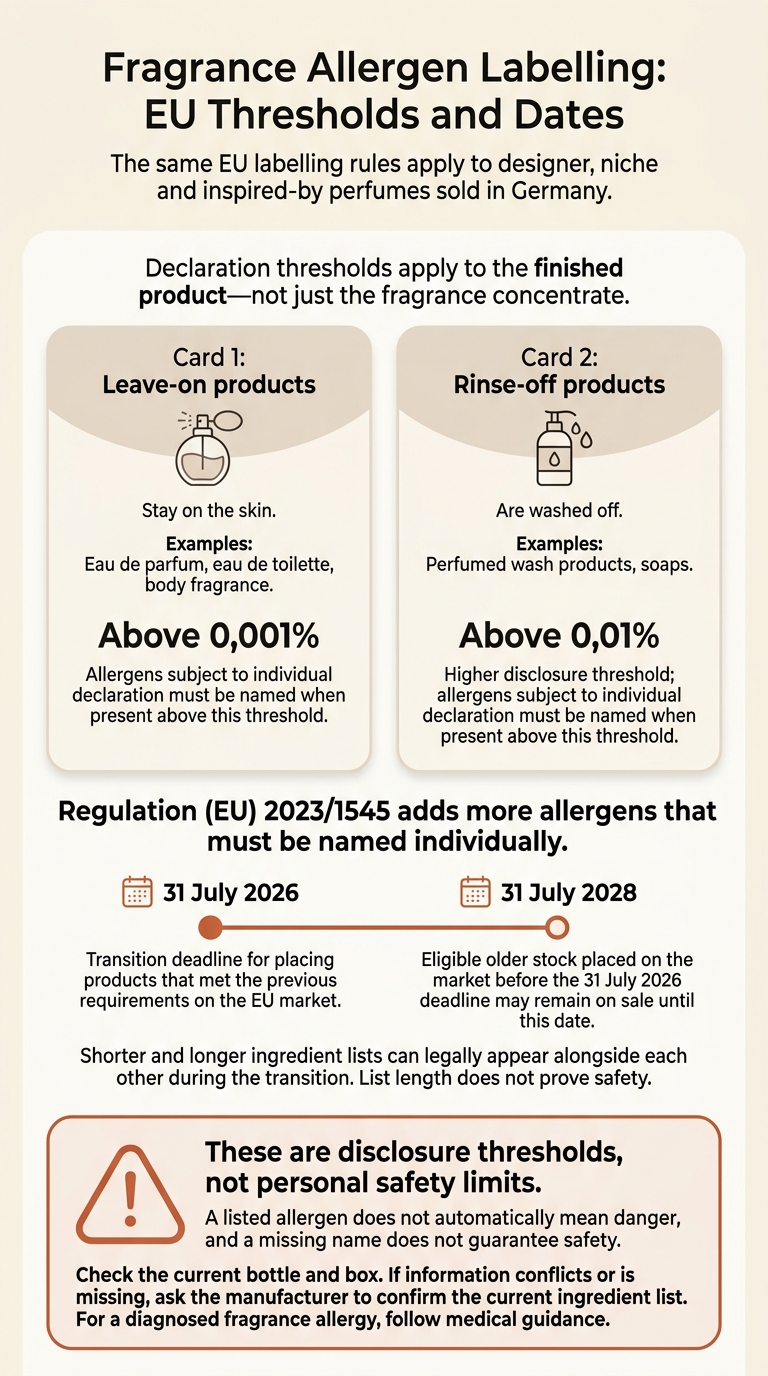
I check the ingredient list before choosing a perfume - not just its scent notes. In Germany, fragrance allergens must be named above 0,001% in leave-on products and 0,01% in rinse-off products. These are labelling thresholds, not personal safety limits.
Here’s what I look for:
The exact product’s ingredients. Similar-smelling perfumes can have different allergen profiles, including Mr. Dupe fragrances and their designer inspirations.
The current packaging. If the box and product page disagree, I ask the manufacturer to confirm the formula.
The labelling rules. The transition deadline for placing products under the previous rules on the EU market was . Eligible older stock can remain on sale until .
31 July 2026
31 July 2028
Medical advice for a diagnosed allergy. Natural ingredients, IFRA compliance and discovery vials do not prove that a perfume suits someone with an allergy.
My rule: <u>a listed allergen does not automatically mean danger, and a missing name does not guarantee safety.</u>
EU Fragrance Allergen Labelling - What Beauty Brands Must Do Before July 2026
the scent. none of the markup.
the same fragrances you already know, interpreted honestly and priced without the label tax.
Fragrance Allergen Labelling: EU Thresholds and Dates
Perfumes sold in Germany follow the same EU Cosmetics Regulation, whether they’re French-made or inspired-by fragrances. Mr. Dupe perfumes use independent formulas, but the same labelling rules apply as for designer and niche fragrances.
Declaration thresholds for perfume
Leave-on products stay on the skin; rinse-off products are washed off. The thresholds apply to the finished product, not just the fragrance concentrate.
Product type
Examples
Declaration threshold in the finished product
What it means
Leave-on
Eau de parfum, eau de toilette, body fragrance
Above 0,001%
Must be named individually
Rinse-off
Perfumed wash products, soaps
Above 0,01%
Higher disclosure threshold
These are disclosure thresholds, not personal safety limits. If you have a diagnosed fragrance allergy, a missing allergen name doesn’t confirm that a perfume suits you. Check the full ingredient list rather than relying on the scent name.
Labelling changes from 31 July 2026
Regulation (EU) 2023/1545 adds more allergens to the list that must be named individually. The transition period for placing products that met the previous requirements on the EU market ended on 31 July 2026.
Older stock placed on the market before that deadline may stay on sale until 31 July 2028. This means shorter and longer ingredient lists can legally appear alongside each other. Check the bottle and box, and ask for the current ingredient list if needed. The length of the list doesn’t prove safety.
Next, check where the ingredient list appears on the bottle, box and product page.
Where to find the ingredient list
Labels can change, so check the bottle, outer box or product page for “Ingredients”. The full list often appears only on the outer box.
INCI is the standard naming system for ingredients on cosmetic labels. Look for names such as Linalool, Limonene and Citronellol. Parfum refers to the fragrance blend. Scent notes, on the other hand, are marketing copy - not an ingredient list. If the page and pack differ, use the current packaging as your starting point and confirm the formula.
Differences between product pages and packaging
Online details don’t replace the packaging label. For allergy checks, verify the packaging first. If the product page and box disagree, ask the manufacturer which formula is current. For Mr. Dupe, email [email protected].
Clear up any missing or conflicting information before buying or using the product, especially if you have a diagnosed fragrance allergy.
Listed allergens and your risk of a reaction
A “natural” claim doesn’t change the risk: natural and synthetic ingredients can both contain fragrance allergens. If you have a diagnosed fragrance allergy, follow medical guidance and check the full ingredient list against the substances you’ve been told to avoid.
Start with the exact Mr. Dupe product page. Use “compare the formulas” to check the Mr. Dupe ingredient list - not just the inspiration scent. Mr. Dupe’s inspired-by fragrances have independent formulas, blended and bottled in Grasse, France.
Allergen differences between inspired-by and original perfumes
A similar smell does not mean the same ingredients. Mr. Dupe’s formulas can match an original perfume’s scent style without matching its allergen profile. Neither scent notes nor brand reputation can predict how your skin will react.
Buying consideration
Mr. Dupe inspired-by perfume
The original fragrance
Product identity
Mr. Dupe’s own composition
The original house’s composition
Ingredient check
Read the current list for the selected Mr. Dupe product
Read the current list for the original product
Mr. Dupe says its formulas use IFRA-compliant ingredients. That does not guarantee they are safe for someone with an allergy. Check the label rather than assuming a perfume contains - or excludes - Linalool, Limonene or Citronellol.
Discovery vials are not allergy tests
Use the scent finder to match your scent preferences only. Sampling also helps you choose a scent; it does not confirm that a perfume is safe for your allergies.
Mr. Dupe’s 2 ml discovery vials let you judge the scent, not your allergy risk. If you have a diagnosed allergy, do not use them to test a suspected trigger.
Perfume buying checklist
Before checkout, give the label one last check.
Check the current INCI list before paying, whether you’re buying from Mr. Dupe or elsewhere. Make sure the product page and packaging match the exact product and size. The packaging label is the reference for that batch.
Read scent notes as marketing copy. Linalool and Limonene are INCI names.
Treat 0,001% as a disclosure threshold, not a safety limit.
Check the labelling date. Older stock may have a shorter list, so check whether the bottle follows allergen labelling rules from before or after 31 July 2026.
If you have a diagnosed fragrance allergy, seek medical guidance before choosing. Take the confirmed ingredient list to your clinician.
FAQs
Do linalool, limonene and citronellol reveal a perfume’s scent?
No. Linalool, limonene and citronellol are listed to identify potential allergens for safety and regulatory compliance. They don’t describe a perfume’s specific scent profile or notes.
To find out what a perfume smells like, use the Mr. Dupe scent finder or browse by fragrance family and notes. Rather than using the complex marketing often seen at other retailers, Mr. Dupe focuses on transparency and high-quality, IFRA-compliant ingredients at a fraction of the cost.
Can allergens below 0,001% still trigger my allergy?
Yes. Allergens below 0,001% can still trigger reactions in highly sensitive people. Labelling thresholds don't account for every person's sensitivity. Even trace amounts can cause contact dermatitis or other allergic reactions in people with established sensitivities.
At Mr. Dupe, we put safety first by using IFRA-compliant ingredients and following international standards designed to minimise known skin irritants. We also offer carefully selected, premium-quality scents.
How can I verify Mr. Dupe’s ingredient list before ordering?
Before ordering, contact Mr. Dupe’s support team to check specific ingredient details. Our product pages explain our standards: clean, cruelty-free and paraben-free formulas made with IFRA-compliant ingredients.
To find a fragrance that suits your preferences, use our scent finder or order our 2 ml discovery vials for 29,00 € to test the scent on your skin first.