Verify 'clean' perfume claims: check INCI, allergens, IFRA, third‑party seals and sampling before you buy.
by mr. dupe editorial, fragrance editors·
Most “clean fragrance” claims still do not prove much in 2026. If I want to shop with less guesswork, I check five things first: the INCI list, named allergens, third-party seals, IFRA compliance, and the sample or return policy.
Here’s the short version:
“Clean” is not a legal or certified term in the EU
IFRA compliance means a fragrance follows safety limits for use levels
EU rules can force brands to list named fragrance allergens above set thresholds, such as 0,001 % for leave-on products
COSMOS and NATRUE are third-party standards for natural or organic cosmetics
Not proof of natural origin, vegan status, or “clean” status
COSMOS / NATRUE
Checked natural or organic cosmetic standard
Not full scent-formula disclosure
Leaping Bunny
No animal testing across the supply chain
Not proof of sensitive-skin suitability
Vegan Society / V-Label
No animal-derived ingredients
Not proof of cruelty-free supply-chain checks
Allergen list
Legal on-pack disclosure under EU rules
Not a full fragrance formula reveal
For inspired-by perfumes, I use the same checks, then look even harder at sampling, returns, and wording like “inspired by” instead of “identical”.
Clean fragrance basics: EU rules, IFRA standards and the terms you see on-pack
What 'clean fragrance' actually means in 2026
In practice, clean fragrance sits on three different layers: EU law, IFRA safety limits, and brand marketing claims. Only the first one is legally enforced. The other two can matter, but they are not legal requirements.
That’s why the smartest place to start is simple: look at the rule behind the claim, not the claim itself.
These terms mean different things and carry different proof levels
A lot of fragrance terms sound similar on the box, but they don’t mean the same thing.
“Natural” refers to where an ingredient comes from. “Vegan” means there are no animal-derived ingredients. “Cruelty-free” means no animal testing, although EU cosmetics law already bans animal testing for cosmetics. “Hypoallergenic” suggests a lower risk of reaction, but under EU law, brands need evidence to back that up.
By contrast, “clean” and “non-toxic” are usually marketing claims, not legal standards. That’s a big difference. A bottle can say clean without meeting any fixed legal definition.
What can shoppers check for themselves? One clear example is allergen labelling. Under EU law, named fragrance allergens such as Limonene, Linalool and Coumarin must appear on leave-on products above 0,001 %. So while a word like clean can be vague, the allergen list is something you can actually verify on-pack.
How EU cosmetics law shapes perfume labels in Germany
For perfumes sold in Germany, the main rulebook is EU Cosmetics Regulation (EC) No 1223/2009. For shoppers, the most useful part is the INCI list. That’s the full ingredient list written with standard international names.
There’s a catch, though. The scent formula itself is usually treated as a trade secret. So instead of seeing the full aromatic mix spelled out, you’ll often just see Parfum or Fragrance on the label.
EU rules also require the net volume in ml. And allergen disclosure is changing. Expanded allergen labelling is being phased in through 2028, which means more named allergens will appear on-pack. That should give shoppers more detail than the current 26-allergen list.
So if labels seem a bit thin today, that’s part of why. The law already sets a base line, and the next round of disclosure will make some labels easier to read in practice.
What IFRA compliance means and what it does not cover
IFRA, the International Fragrance Association, publishes standards that limit or ban certain fragrance materials based on toxicological data. Think of it as a safety framework for formula use. It is not the same thing as a clean label.
When a brand says “IFRA compliant,” it means the formula stays within those industry safety limits. That tells you something useful, but not everything. It does not tell you if the ingredients are natural or synthetic, how they were sourced, or whether the formula avoids a material you personally don’t want to use.
So IFRA compliance is a baseline for safety. It is not proof of a brand’s wider claims.
The main fragrance certifications and labels worth checking
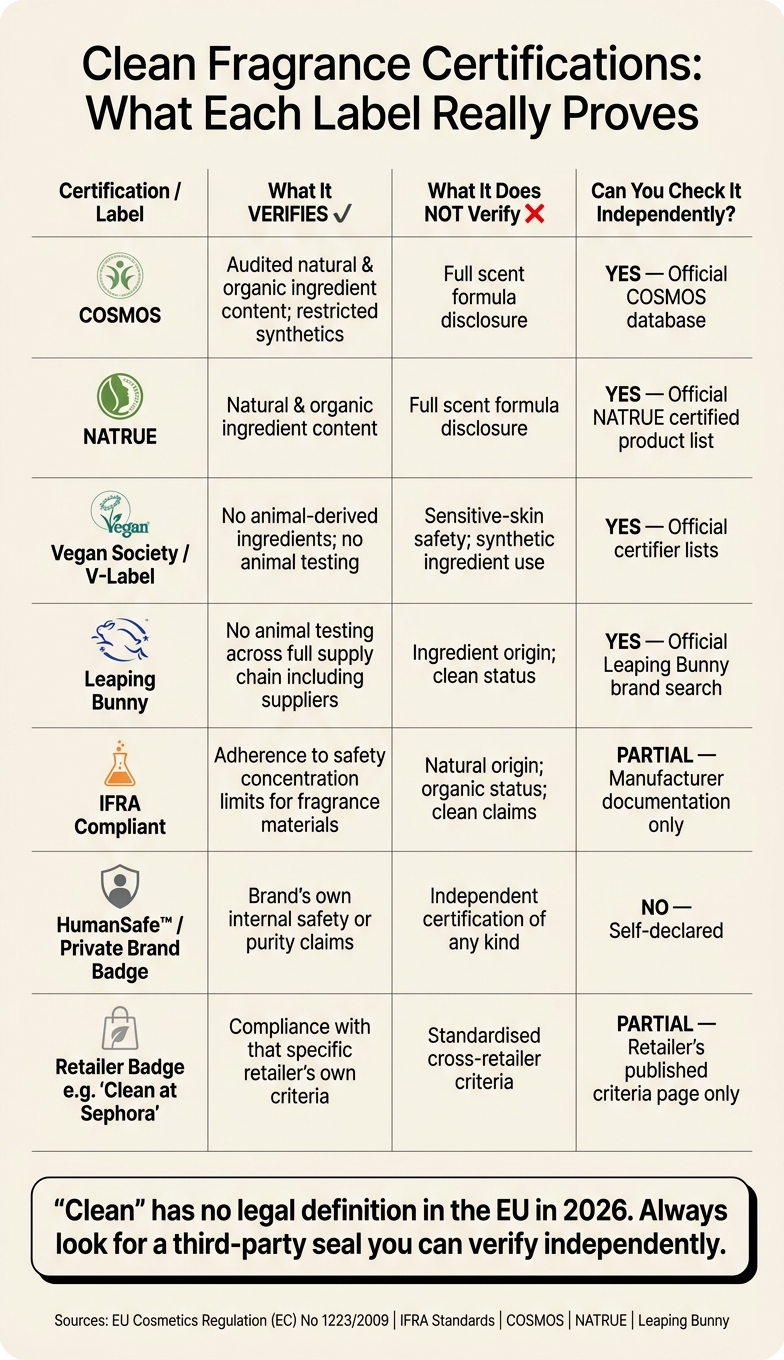
Clean Fragrance Certifications Compared: What Each Label Really Proves
Once you know the rules, the next step is simpler: figure out which labels actually mean something when you're about to buy.
Natural and organic standards: COSMOS and NATRUE explained
COSMOS and NATRUE are third-party standards for natural and organic cosmetics. That matters because the check comes from an outside certifier, not just the brand itself.
Both standards look at natural and organic ingredient content and limit certain synthetic substances. If you want to double-check a product, you can do that through each certifier’s public online listings.
One small catch: a high “natural” percentage can include the alcohol and water base. So the figure on the pack may not tell you much about the scented part of the formula.
Vegan and cruelty-free labels: what they confirm for EU perfume buyers
The labels you’ll spot most often are the Vegan Society mark and Leaping Bunny, along with plain claims like “100% Vegan” or “Cruelty-Free.” These indicate that the product contains no animal-derived ingredients and involves no animal testing.
Leaping Bunny goes a step further. It checks the supply chain, not just the finished item. That gives it more weight than a simple on-pack claim.
Still, these labels have limits. They do not tell you whether a perfume is safe for sensitive skin, free from synthetic ingredients, or part of any broader “clean” standard.
Brand-owned badges, retailer badges and self-declared claims
This is the part where things get messy. Some labels look official but aren’t checked by any outside body.
"HumanSafe™ Verified", "clean formula" and "non-toxic" are usually self-declared, not independently verified.
Retailer badges work in a similar way. Labels like “Conscious” or “Clean at Sephora” are based on that retailer’s own internal rules, and those rules can differ a lot from one shop to another.
That doesn’t mean the claims are false. It just means they can’t be checked in the same way as a COSMOS or Leaping Bunny logo. A simple rule helps here: if there’s no outside organisation you can look up, treat it as marketing rather than certification.
Comparison table: certifications, what they verify and where to confirm them
Certification / Label
Category
What it verifies
What it does NOT verify
Where to confirm
Relevance for perfume shoppers in Germany
COSMOS
Natural / Organic
Audited natural and organic ingredient content; restricted synthetics
Full scent formula
Official COSMOS database
More common on body mists and perfume oils than fine fragrances
NATRUE
Natural / Organic
Natural and organic ingredient content
Full scent formula
Official NATRUE certified product list
More relevant for cosmetic-adjacent scented products
Vegan Society / Cruelty-Free
Ethical
No animal-derived ingredients; no animal testing
Sensitive-skin safety; synthetic ingredient use
Official certifier lists
Common on independent and inspired-by brands
Leaping Bunny
Cruelty-Free
No animal testing across supply chain, including suppliers
Ingredient origin; clean status
Official Leaping Bunny brand search
Stronger supply-chain assurance than product-only claims
IFRA Compliance
Safety Standard
Adherence to safety concentration limits
Natural origin; organic status; clean claims
Manufacturer documentation
Useful baseline; not a clean label
HumanSafe™ / Private
Brand-Owned
Brand's internal safety or purity claims
Independent certification
None (self-declared)
Treat as marketing unless methodology is published
Retailer Badge ("Clean at Sephora" / "Conscious")
Retailer-Assigned
Compliance with that retailer's own criteria
Standardised cross-retailer criteria
Retailer's published criteria page
Always check the actual exclusion list
Next, use these labels as a quick filter before you compare product pages, price, and ingredient proof.
How to compare clean fragrance claims before you buy
How to read a fragrance label or product page in 5 checks
Ignore the visuals. Start with the ingredients or transparency section. Those badges and pretty graphics only matter if you can back them up at checkout.
Here’s a quick way to check a fragrance page without getting lost in the marketing:
Certification logos first: Look for recognised third-party marks like COSMOS or NATRUE, plus cruelty-free logos such as Leaping Bunny. If the page only shows icons made by the brand itself, treat them with caution. They may not be checked by an outside body.
Check the INCI list: A helpful product page gives you more than “Parfum, Alcohol, Water.” Look for the full INCI list and any extra disclosure the brand shares.
Scan for declared allergens: See whether mandatory allergen disclosure is listed. If it’s missing, that’s worth noting.
Verify ethical claims: If a product says “vegan” or “cruelty-free,” check for a recognised logo or a listing from the certifier. Don’t just take the wording at face value.
Look for IFRA compliance: See whether the page clearly states IFRA compliance. That’s one of the few claims with a direct technical meaning.
Marketing claim versus verified proof: how to spot weak language fast
Some claims sound good but don’t tell you much.
“Chemical-free” means nothing. Everything is made of chemicals. “Non-toxic” is often just marketing unless the brand shows what it leaves out.
The clearest warning sign is simple: a vague claim with no ingredient list. Pick specific proof over broad reassurance. A published “no-go” list, such as clearly saying there are no phthalates or parabens, tells you far more than a banner headline.
How to compare value
Once the proof checks out, compare the price per ml. A higher price doesn’t mean stronger proof. Price per ml in euro is one of the simplest ways to compare two fragrances on equal terms.
Divide the total price by the bottle size. For example:
A 50 ml bottle at 45,00 € works out to 0,90 € per ml
A 100 ml bottle at 65,00 € works out to 0,65 € per ml
Price isn’t the whole story, though. Check whether the brand offers sample sizes, usually 5 ml to 10 ml, before you commit to a full bottle. It also helps to look at the free-shipping threshold, since that can change the final cost more than people expect.
Comparison table: claims, technical meaning, evidence and red flags
Claim
Technical Meaning
Evidence to Look For
Red Flags
IFRA Compliant
Meets safety standards for ingredient concentration levels
Explicit mention of IFRA standards on the product page
Vague “skin-safe” claims with no reference to IFRA
Clean / Non-Toxic
Marketing term; no legal definition in 2026
A published “No-Go” list (e.g., no phthalates, parabens) and a full INCI list
Used as a standalone buzzword with no ingredient disclosure
Natural
Ingredients derived from plants or minerals
Percentage of natural content stated clearly; COSMOS or NATRUE logo
Claims that a formula is “natural” because the alcohol base is natural
Vegan
No animal-derived ingredients
Vegan Society logo or a clear “no animal products” statement
“Cruelty-free” used interchangeably - this only covers testing, not ingredients
Cruelty-Free
No animal testing on the finished product or its ingredients
Leaping Bunny or PETA logo
“We don’t test on animals” with no mention of supplier practices
Next, apply the same checks to inspired-by perfumes, where proof matters even more than branding. Use the same proof-first checks on inspired-by perfumes, where samples and returns reduce risk.
Inspired-by perfumes: how to apply the same checks
Inspired-by perfumes need the same proof-first checks. But with this category, you also need to look more closely at claim support and trial policy.
Which clean and ethical checks matter most for inspired-by fragrances
Inspired-by doesn’t mean cleaner. It also doesn’t mean less clean. The only thing that matters is the product listing, not the brand story.
Use the same proof checks as you would elsewhere: IFRA, full INCI, allergen details, and verified vegan or cruelty-free claims. Treat “clean” as marketing unless it’s backed by a third-party standard.
Be extra careful with equivalence claims like “exact match” or “smells identical.” Those claims need proof. As lawyers Bisman Kaur and Aarti Aggarwal from Remfry & Sagar have noted:
"Assertions of equivalence in quality, composition, performance or longevity must be capable of substantiation."
If a brand can’t show support for that kind of claim, read it as marketing, not fact.
Once those claims hold up, the next step is simple: can you test the scent without paying too much for a blind buy?
Why sampling and returns matter more than branding
Fragrance shifts on skin, and the dry-down is often the deal-breaker. That’s why sampling matters so much. Discovery sizes, small vials, and clear return terms can save you from buying a full bottle you won’t wear.
Before you check out, look for:
A sample, discovery set, or smaller size
A clear return or exchange policy
No test size and no exchange option? That’s a red flag.
Where EU shoppers can compare inspired-by fragrances with more clarity
Once you’ve checked the label, look at the shop itself. Price, samples, returns, and product-page proof matter just as much.
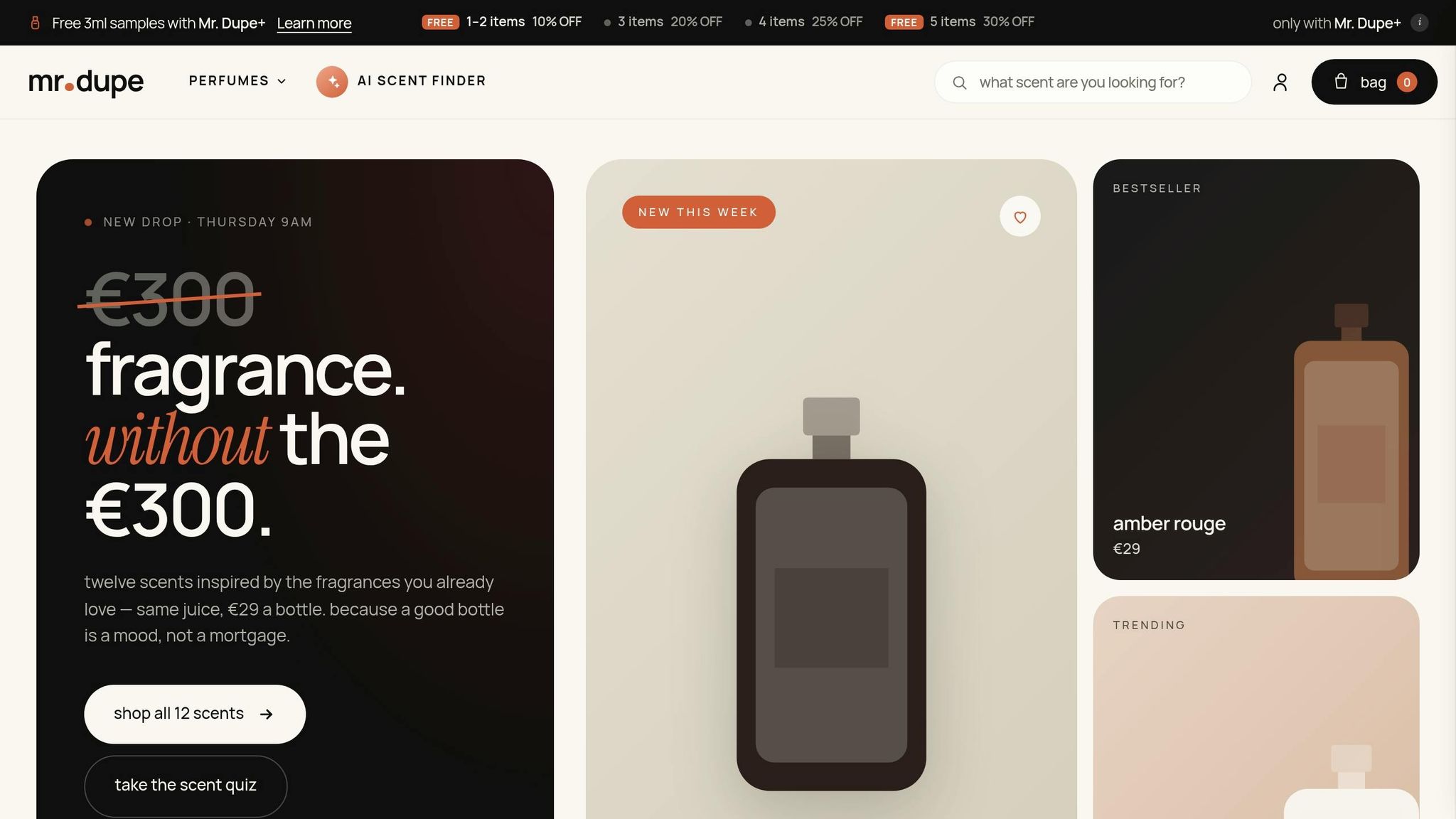
Unlike marketplaces, Mr. Dupe puts formula details, pricing, and policy info in one place. It isn’t a marketplace. It makes its own inspired-by fragrances, produced and bottled in Grasse, France. Mr. Dupe is a single-brand shop with EUR pricing, EU shipping, 30-day returns on opened bottles, vegan and cruelty-free formulas, free 2 ml discovery vials, and 50 ml bottles from €29. The point here isn’t the scent story. It’s how much proof you can see before checkout. If you’re unsure where to begin, the scent finder can match fragrances by notes, mood, or scents you already love.
Use the checklist below to compare any inspired-by product page in less than a minute.
What to check on an inspired-by perfume product page before checkout
Use this checklist on any inspired-by product page before you buy:
What to check
What to look for
Bottle size and price
Clearly stated in ml and EUR
Sampling option
Free or low-cost discovery vial available
Return policy
Clear 30-day window, ideally on opened bottles
Full INCI list and allergen disclosure
Listed on the product page, not hidden
Vegan and cruelty-free labels, if stated
Backed by a recognised logo or clear statement
IFRA compliance, if listed
Explicitly mentioned, not implied
Scent claims
"Inspired by" language, not "identical" or "exact match"
If two products seem close, these details often tell you which one is the safer buy. Missing two or more of them? That’s a good sign to slow down and look closer before placing the order. Vague wording without proof usually means more risk.
Conclusion: a short checklist for buying with more confidence in 2026
Use the same proof-first rule for both standard and inspired-by perfumes: check labels first, then look at price.
“Clean” is a marketing term, not a certification. Buy based on proof: third-party seals, INCI disclosure, named allergens, and IFRA compliance.
IFRA confirms safety limits. It does not confirm natural origin or ethical sourcing.
Price doesn’t prove quality, safety, or transparency.
Final buyer checklist: proof, labels, value and risk reduction
Use this as your final check before checkout.
What to check
Why it matters
Where to find it
When to avoid it
Full INCI list with named allergens
EU legal requirement and a key sign of transparency
Product packaging or ingredients tab
Only “Parfum/Fragrance” listed and no allergen disclosure
Third-party certification seal
Shows the claims were checked by an outside body
Bottle, box, or official certification page
Brand-made icons with no outside certifier
IFRA compliance statement
Shows the formula stays within IFRA safety limits
Product page, FAQ, or “About” section
No mention of safety standards anywhere on the site
"Inspired by" language, not "identical"
Helps you avoid misleading match claims
Product title and description
Phrases like “exact copy” or “same as” without evidence
Sample or return option
Lowers money risk on a very subjective purchase
Checkout page or FAQ
No sample or return option
If a product ticks all five boxes, you have enough information to make an informed choice. If two or more are missing, slow down. That gap between the sales claim and checked proof is usually where the risk sits.
For inspired-by fragrances, the safer buy is the one with proof you can verify before checkout.
FAQs
How can I verify a fragrance seal?
Don’t rely on a fragrance seal or label alone. Check whether the product shows clear, readable, and verifiable standards, along with ingredient or safety compliance signals.
Look for documented claims such as HumanSafe™ Verified/Transparency and stated frameworks like IFRA compliance. That’s very different from vague marketing copy. If a seller leans on phrases like “inspired by” or “dupe” but gives no clear safety or compliance details, treat that seal as non-verifiable.
Does IFRA compliance mean a perfume is safe for sensitive skin?
No. IFRA compliance does not automatically mean a perfume is safe for sensitive skin. It sets baseline industry rules for fragrance ingredient use, not a special standard for skin sensitivity.
Some IFRA-compliant ingredients can still trigger reactions in people with specific sensitivities or allergies. If you want a gentler option, look for brands that are open about what they use and offer alcohol-free or skin-safe carrier oil formulas, such as Mr. Dupe.
What should I do if a perfume page hides the full INCI list?
Treat it as a transparency red flag. Don’t rely on clean or other marketing-only wording.
Go for products that clearly show their ingredients and any standards they follow. If you’re shopping for inspired-by perfumes, pick retailers with full, readable ingredient lists instead of partial lists or vague catch-all claims. If you can’t check what’s inside, you can’t compare compliance in a fair way, so skip it and look for a product with a complete list.