How Grasse Makers Build Small-Batch Scents | mr. dupe | mr. dupe
guides
How Grasse Makers Build Small-Batch Scents
Step-by-step look at Grasse small-batch perfume making: brief, materials, blending, maceration, filtering, and hand bottling.
by mr. dupe editorial, fragrance editors·
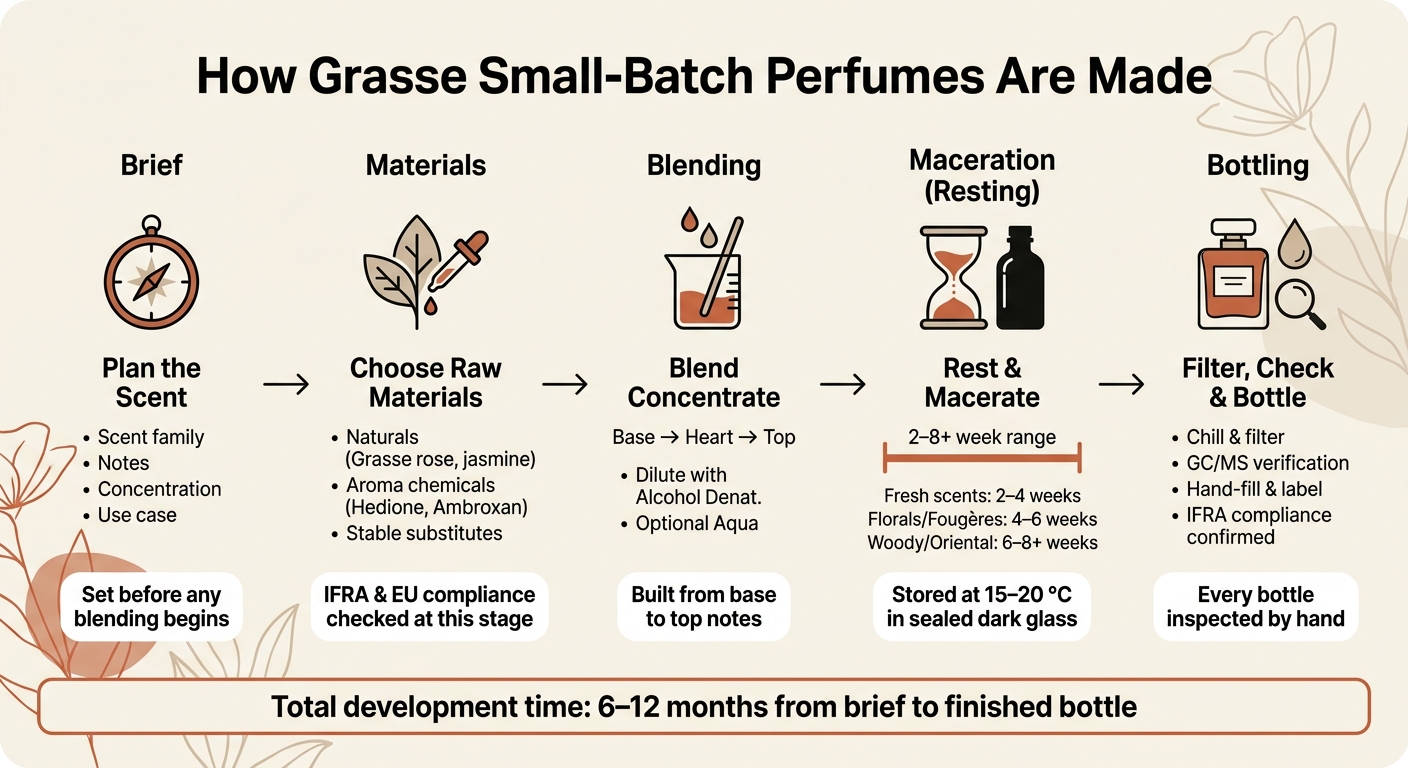
Small-batch perfume making in Grasse comes down to five steps: brief, materials, blending, resting, and bottling. In most cases, development takes 6 to 12 months, and the resting stage alone can run from 2 to 8+ weeks, depending on the formula.
If I had to sum up the process in plain terms, it would look like this:
I start with a clear scent brief
I pick naturals, aroma chemicals, and substitutes that stay stable
I blend the concentrate from base to top
I dilute with Alcohol Denat. and sometimes a little Aqua
I let the batch rest at 15–20 °C
I chill, filter, test, bottle, and label by hand
I check that the formula meets IFRA and EU rules before release
Naturals like Grasse rose and jasmine add character, but they can shift in cost and supply
Aroma chemicals such as Hedione and Ambroxan help with lift, wear, and batch-to-batch consistency
For buyers, the result is often a cleaner opening, a smoother dry-down, and less guesswork
Here’s the process at a glance:
Stage
What I focus on
Typical range
Brief
Scent family, notes, use, strength
Set before blending
Materials
Naturals, synthetics, substitutes
Based on cost, stability, rules
Pilot batch
Small test volume
Kept small to cut waste
Maceration
Resting after dilution
2–8+ weeks
Final checks
Smell, clarity, filtration, compliance
Before bottling
This article shows that Grasse small-batch work is less about hype and more about careful weighing, patient resting, and close manual checks - especially for inspired-by perfumes sold in the EU at prices far below many luxury originals.
Grasse Small-Batch Perfume Making: 5-Step Process Guide
Step 1: Plan the Scent, Raw Materials, and Batch Size
Set the Scent Brief and Target Profile
Once the direction is clear, the maker sets the target profile. Before weighing even one raw material, the perfumer decides the fragrance family, the key notes, the concentration, and how the scent will be used. That brief guides the top, heart, and base of the formula.
For inspired-by scents, makers study the reference fragrance and map its core accord. The aim is to build an original take on that accord, adjusted for cost or ingredient limits. Pick the concentration at this stage. If you change it later, you’ll need to reformulate.
Choose Naturals, Aroma Chemicals, and Stable Substitutes
With the brief locked in, the next step is choosing materials. Small-batch makers in Grasse often blend naturals like Grasse rose and jasmine with aroma chemicals such as Hedione for floral lift and Ambroxan for woody depth. Naturals bring character. Aroma chemicals help with consistency and cost control.
When naturals are expensive or hard to source in a steady way, makers turn to synthetic substitutes. If the perfume will be sold in the EU or Germany, every chosen material needs to comply with IFRA and EU cosmetic rules.
Decide Batch Size, Tools, and Resting Timeline
Pilot batches are usually kept small. That cuts waste and makes it easier to tweak the formula before scaling up.
The batch also needs time to macerate before filtration and bottling. Set that maceration window now, because it depends on the formula and on the filtration step that comes next.
With the brief, materials, and batch size set, the maker can move on to weighing and blending the concentrate.
the scent. none of the markup.
the same fragrances you already know, interpreted honestly and priced without the label tax.
Step 2: Blend the Concentrate and Dilute to Perfume Strength
Build the Formula from Base to Top Notes
Start with the base and work upward. Put the depth in first, then add the lift at the end.
Use musk, cedarwood, and sandalwood for depth. Build the heart with Grasse rose, violet, peony, and orange blossom. Add bergamot and aldehydes last, since they evaporate the fastest. Hedione and Ambroxan help push the florals forward and make the woody base last longer.
Before you dilute anything, test the concentrate on blotters and on skin. That gives you a clear read on both the opening and the drydown.
Dilute with Alcohol and Optional Water
Once the concentrate passes its first test, bring it down to perfume strength.
When the balance feels right, dilute the concentrate with perfumer's alcohol (Alcohol Denat.). Add a small amount of water (Aqua) only if needed.
Adjust for Naturals, Resins, and Clarity Issues
If the formula leans heavily on naturals or resins, check it for haze, colour shift, and separation before maceration. If the dilution stays clear and stable, let the batch rest, then chill it, filter it, and bottle it.
How I Make Small Batch Fragrances
Step 3: Rest, Filter, and Hand-Finish the Batch
Once the concentrate has been diluted, the blend needs time to settle before you can judge the final result.
Macerate Under Controlled Conditions
Let the diluted blend rest in sealed dark glass or stainless steel containers with as little headspace as possible. Keep it at 15–20 °C for:
2–4 weeks for fresh scents
4–6 weeks for florals and fougères
6–8 weeks or more for woody or oriental formulas
This waiting period matters. A fragrance can smell a bit rough or uneven right after dilution, then come together after a few weeks.
Chill, Filter, and Check the Juice
After resting, makers check the batch for consistency before bottling. They retest the fragrance on skin and blotter through the opening, heart, and dry-down. If the balance has shifted, the formula can still be adjusted at this stage.
Some makers also use GC/MS to verify the sample, then fine-tune the formula by nose. It’s a mix of lab check and human judgment, which makes sense in perfumery. Numbers can tell you a lot, but your nose still has the last word.
Bottle, Label, and Inspect by Hand
Because batch sizes stay small, manual or semi-manual filling is standard. Labels are applied by hand, and each bottle is checked for clarity and overall finish. Before release, makers confirm that the batch meets IFRA standards.
That last bit of hand-finishing is what helps small-batch inspired-by scents stay consistent enough to compare, bottle, and sell.
How Grasse Small-Batch Craft Connects to Inspired-By Perfumes at Mr. Dupe
Why Small-Batch Methods Work Well for Inspired-By Scents
The same small-batch control fits inspired-by perfumes especially well. In this part of perfumery, the aim is recognition, not duplication. A perfumer needs space to fine-tune the signature accord, the core of the scent people notice first and remember later, without the demands of mass output.
That matters because a good inspired-by fragrance should bring back the feeling of a known scent without copying it outright. To get there, the opening needs to smell clean, and the dry-down needs to feel smooth and settled. Small-batch blending helps with that. So does resting time, which gives the formula a chance to come together properly.
For shoppers, that work tends to show up in simple, noticeable ways:
This is also why discovery vials and note-based search make sense. They reflect how perfumers test, compare, and adjust a scent. Mr. Dupe composes and bottles its fragrances in Grasse, France, with the same small-batch approach described throughout this guide.
The offer is pretty straightforward. Mr. Dupe sells 50 ml bottles for €29,00 and includes free discovery vials, so you can try a scent on skin before you commit. The scent finder can also point you toward a match based on notes, mood, or fragrances you already enjoy.
Luxury originals like Creed Aventus retail at roughly £310 for 100 ml. That puts Mr. Dupe’s €29,00 price point in clear contrast. And there’s another difference: instead of acting only as a marketplace seller or relying only on an online finder, Mr. Dupe keeps production in Grasse and connects that guidance to the finished fragrance itself.
For shoppers in Germany and across the EU, that can make the buying process feel a lot simpler. EU-friendly checkout in euros, vegan and cruelty-free formulas, and 30-day returns, even on opened bottles, lower the risk when you can’t test everything in person first.
Conclusion: What to Take Away from Grasse Small-Batch Perfumery
Precise planning, controlled blending, patient maceration, and hand-finishing help keep a fragrance balanced from the first spray to the dry-down. For shoppers in Germany and across the EU who want to explore that craft through inspired-by scents, Mr. Dupe brings together Grasse production, clear EUR pricing, and free discovery vials in one place.
FAQs
Why does maceration matter so much?
Maceration matters because it gives blended ingredients time to settle, come together, and fully develop before bottling. It helps the top, heart, and base notes blend into one another, so the scent reaches the depth and performance it was meant to have.
For shoppers who care about that level of attention, Mr. Dupe offers a better experience than many mass-market options by giving each inspired-by scent the time it needs to bloom.
How do makers keep small batches consistent?
Makers keep small batches consistent by locking the formula to a defined signature accord: top, heart, and base notes. They also control ingredient choices and concentrations, so the scent stays in line from one batch to the next.
Before bottling, they check how the fragrance develops on skin and blotters. They also allow for raw material variation and how the scent settles during the rest period, so each batch matches the target dry-down, not just the opening.
Why use both naturals and aroma chemicals?
Perfumers use both because each serves a different job.
Natural materials bring the distinct, evocative sides of plants. Aroma chemicals, on the other hand, can add steady structure, help a scent last and perform better, and reduce limits tied to cost or supply.
Used together, they help create a fragrance that feels beautiful while still being blended with consistency at scale.