Inspired-By Perfumes: Natural or Synthetic Mix? | mr. dupe | mr. dupe
guides
Inspired-By Perfumes: Natural or Synthetic Mix?
Most inspired-by perfumes blend natural extracts with synthetic molecules; balance determines scent match, longevity, and safety.
by mr. dupe editorial, fragrance editors·
Most inspired-by perfumes use both natural materials and synthetic aroma molecules. If I had to sum it up in one line, that’s the answer.
Here’s the short version:
Synthetics usually do most of the work for scent matching, wear time, and batch-to-batch stability.
Naturals add depth, texture, and a more layered smell.
Neither side is perfect on its own.
Safety is not as simple as “natural = better”. Both naturals and synthetics can contain allergens.
In the EU, I’d check REACH compliance, ingredient transparency, and whether the scent claims sound specific instead of vague.
In other words: if you want an inspired-by perfume that smells close to a known scent and lasts well on skin, the thing to judge is the formula mix, not just the word natural on the label.
A useful fact: in modern perfumery, many well-known scents rely heavily on synthetic molecules because they give more stable results across batches. Natural raw materials can vary from harvest to harvest, sometimes by a noticeable margin. That variation can change how a perfume smells from one bottle to the next.
Part
What it usually does
Natural materials
Add nuance and texture
Synthetic molecules
Help with scent match, wear, and consistency
Carrier and fixatives
Help the perfume spray, settle, and last
So when I assess an inspired-by perfume, I look for three things first: how close it smells, how long it lasts, and how clear the brand is about what’s inside.
What inspired-by perfumes typically contain
Most inspired-by perfumes are built from three main parts: a carrier, a fragrance concentrate, and a blend of natural materials and synthetic aroma molecules. That combination is what makes scent matching possible.
Perfume labels usually show broad ingredient categories, not the full recipe.
Carrier, concentrate, and fixatives and stabilisers
The carrier base is usually alcohol or water. The fragrance concentrate gives the perfume its main smell, while fixatives and stabilisers help round it out and make it last longer. The next section explains why synthetics usually do most of the heavy lifting when it comes to matching a scent.
Where natural ingredients appear in the blend
Natural ingredients can be part of the concentrate, but they rarely make up the whole formula on their own. They add depth and nuance, but they don't usually define the scent by themselves.
the scent. none of the markup.
the same fragrances you already know, interpreted honestly and priced without the label tax.
Why synthetic molecules are usually needed for scent matching
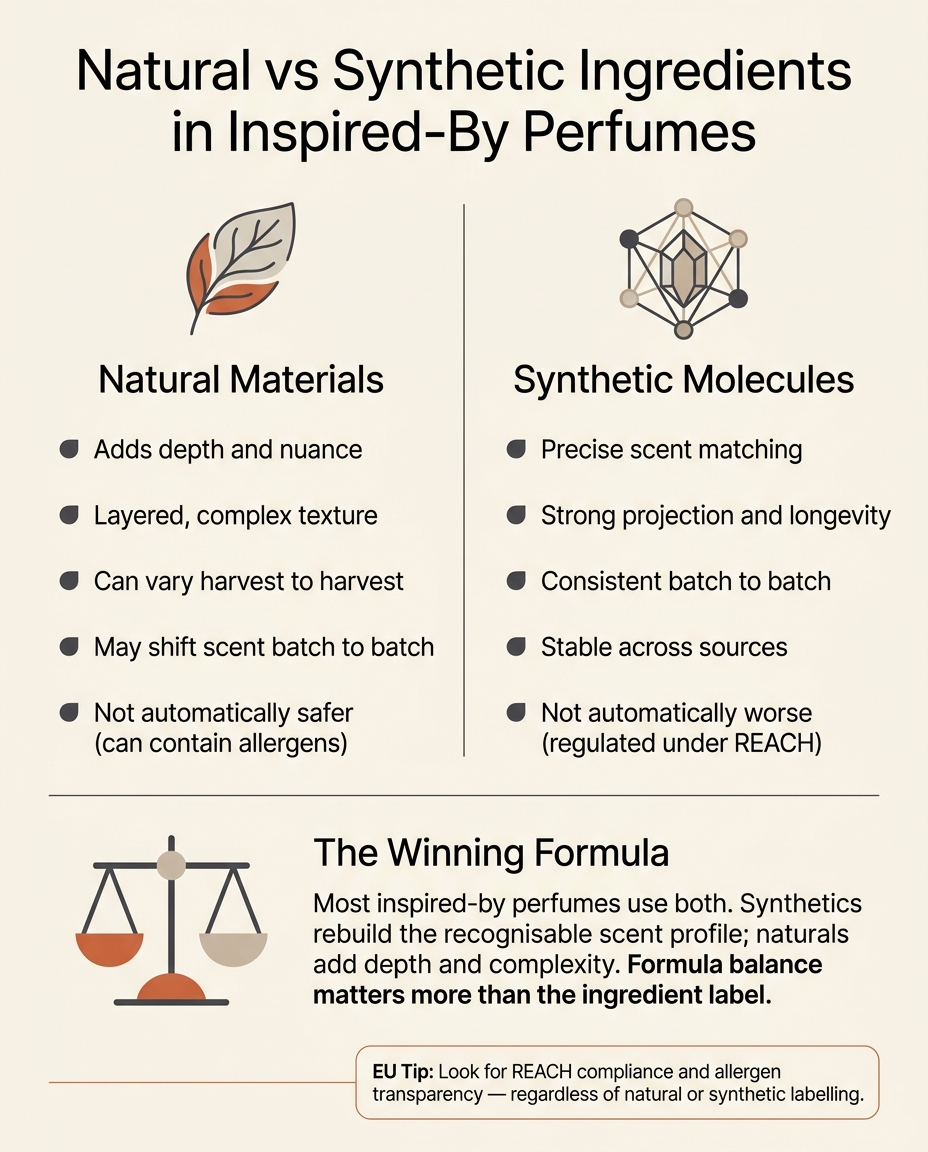
Natural vs Synthetic Ingredients in Inspired-By Perfumes
Once the base blend is in place, synthetic molecules usually do the heavy lifting when it comes to rebuilding a scent people instantly recognise.
Consistency, longevity, and recognisable scent profile
Synthetics make it easier to match a target scent with more precision. They give you cleaner consistency, stronger projection, and longer wear than naturals on their own. That matters because natural materials can shift from one harvest to the next and from one source to another.
If you’re trying to recreate a familiar perfume profile, that variation can throw everything off. A rose absolute from one season may smell a little richer, greener, or softer than the next. Synthetic materials help smooth out those swings, so the scent stays closer to what people expect.
Natural vs synthetic materials: a side-by-side comparison
Natural materials bring texture and nuance. Synthetic materials bring accuracy, stability, and repeatability.
In inspired-by perfumes, the strongest formulas usually use both. That mix helps keep the scent recognisable while still giving solid wear performance. So yes, naturals still matter. But in practice, formula balance matters more than the ingredient label alone.
Why naturals still matter and how to judge formula balance
Naturals still matter. They can add depth and a more layered feel that synthetics on their own often miss. In many inspired-by perfumes, the goal is to balance scent match with wear time. That’s why it makes more sense to look closely at the full formula than to focus on ingredient type alone.
Natural does not always mean safer, and synthetic does not always mean worse
This is where a lot of shoppers get tripped up. Words like clean or natural can sound reassuring, but they don’t automatically mean a formula is safer or more ethical. Both natural and synthetic ingredients can trigger allergens, and both fall under rules such as REACH (Registration, Evaluation, Authorisation and Restriction of Chemicals) in the EU. What matters most is formula balance and EU compliance.
What to check before you buy
Once you see that, the next step is simple: check the formula, not the marketing. Before you buy, look at the scent description, the performance claims, and whether the formula sounds balanced. If a perfume promises everything at once but says almost nothing concrete, that’s usually a sign to slow down.
For a practical EU-friendly option, Mr. Dupe makes browsing easier with scent filters and a scent finder.
Inspired-by perfume buying checks at a glance
What to check
What to look for
Formula balance
Fidelity to the original scent and good wear
Safety and regulation
Compliance with REACH
Allergen awareness
Allergen risk exists in both naturals and synthetics
Scent profile honesty
Clear description of the target scent profile
Performance claims
Realistic and specific, not vague
Conclusion: In inspired-by perfumery, the formula balance matters more than the label
The main point is simple: most inspired-by perfumes use both synthetic molecules and natural ingredients. Synthetics help rebuild a familiar scent profile and keep performance more consistent, especially when it comes to longevity and projection. Naturals bring depth, nuance, and complexity. What counts most is the balance of the formula, not some idea of ingredient purity.
That’s also why sampling before buying makes so much sense. Generic marketplaces can feel a bit like guesswork. Mr. Dupe, on the other hand, lets shoppers filter by note, family, and inspiration before they order. For shoppers in the EU, Mr. Dupe’s discovery vials and scent finder make it easy to test scents first.
On skin, performance and fit matter more than the ingredient label.
FAQs
Why are synthetics used so much?
Synthetics play a key role in perfume creation because they bring consistency, stability, and staying power that natural ingredients on their own often can’t match.
When used with blended naturals, they help perfumers recreate complex scent profiles with precision and keep the fragrance stable over time. At Mr. Dupe, that balance helps deliver inspired-by scents that smell polished and last well.
Can a natural perfume match a designer scent?
Usually, no.
Matching a designer scent with close accuracy often depends on synthetic molecules, along with high-quality natural ingredients. That mix helps achieve the right scent profile, plus stability, longevity, and consistency.
What makes the difference is the formula balance. When those parts are blended with care, they can recreate the layered structure of a complex fragrance.
How can I tell if a formula is well balanced?
A well-balanced perfume formula blends synthetic molecules and naturals so that no single note takes over. The result should feel smooth and even, not sharp or patchy.
You can usually spot this in the way the scent shifts from top to heart to base notes. It should move cleanly, without harsh spikes or obvious gaps. At Mr. Dupe, this kind of balance is a core part of our inspired-by fragrance formulations.