7 Layering Mistakes to Avoid with Dupe Perfumes | mr. dupe | mr. dupe
guides
7 Layering Mistakes to Avoid with Dupe Perfumes
Avoid seven common dupe perfume layering mistakes: use one base + one accent, test on skin, and log results.
by mr. dupe editorial, fragrance editors·
Most bad perfume layers fail for the same 7 reasons: too much spray, clashing notes, no skin test, too many scents, poor order, poor placement, and no set ratio. If I keep it to 1 base scent + 1 lighter accent, test on skin, and review the blend after 30 minutes and again after 4–6 hours, I waste less juice and get a cleaner result.
This matters even more with dupe perfumes. Even at around €29 for 50 ml, bad mixing can empty bottles fast. And in Germany, where close-contact settings like offices and public transport are common, a soft, skin-close result usually works better than a strong scent cloud.
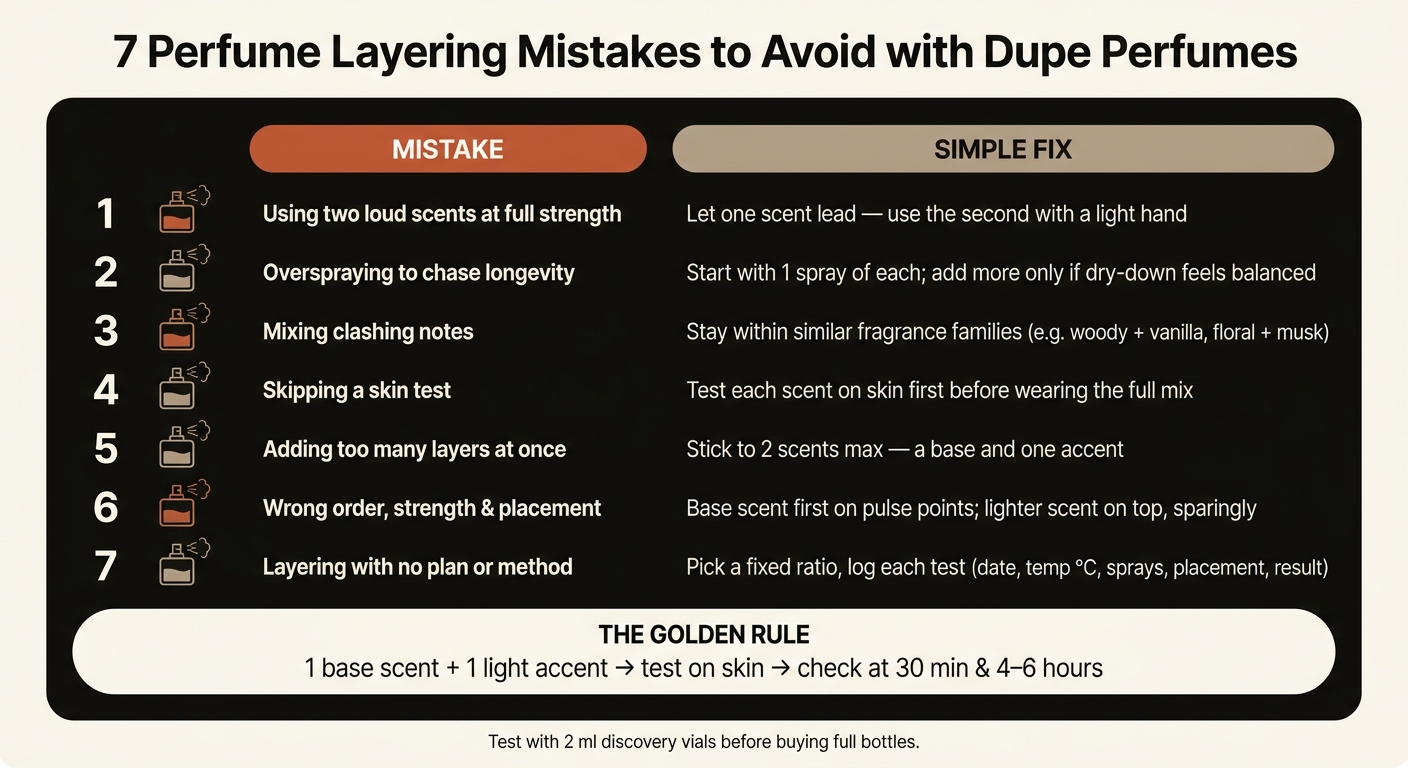
Here’s the whole article in one quick view:
Mistake 1: Using two strong scents at full power
Mistake 2: Overspraying to make it last
Mistake 3: Mixing notes that fight each other
Mistake 4: Skipping a skin test
Mistake 5: Adding too many layers
Mistake 6: Ignoring strength, order, and spray placement
Mistake 7: Layering with no clear plan
What I’d do instead:
Start with 1 spray + 1 spray
Use one scent as the base
Let the first spray sit before adding the second
Test on clean skin with unscented moisturiser
Log the result with date, weather, placement, and wear time
Check the blend after 30 minutes and after 4–6 hours
7 Perfume Layering Mistakes & Simple Fixes
🛑 STOP! You’re Wearing Perfume Wrong! 6 Mistakes That Make Your Fragrance Disappear
the scent. none of the markup.
the same fragrances you already know, interpreted honestly and priced without the label tax.
If I want layering to work, I need to keep it simple, test in small amounts, and repeat only what works.
Why Layering Mistakes Cost More with Dupe Perfumes
Inspired-by perfumes are all about value. So when a layering combo burns through juice and still doesn’t smell good, each wasted spray stings a bit more. The whole point of dupe perfumes is low-cost testing and trying new things without spending a fortune. A poor blend can wipe out that upside fast.
That’s why the first mistake has less to do with price and more to do with how the scents behave together.
The fix is simple: give each scent a clear role. When layering goes wrong, the notes get muddy and the wear time often drops. What started as a clean scent profile turns into something blurred. Layering shouldn’t make both perfumes louder. One should anchor the mix, and the other should lift it.
In Germany, a subtle and balanced layering style is often easier to wear day to day and easier to defend as money well spent. The mistakes below show where layered dupe perfumes usually slip up.
1. Using Two Loud Dupe Perfumes at Full Strength
When you use two loud dupe perfumes at full strength, they tend to clash instead of blend. Each one tries to take over, so the mix can smell harsher, the notes get muddy, and the scent often burns off sooner.
A better move is to let one fragrance lead and use the second with a light hand. That way, you get more shape, less chaos, and a mix that smells far more put together.
2. Overspraying to Chase Longevity
Once the balance is right, the next mistake is trying to force longer wear with extra sprays.
More spray doesn't mean your scent will last longer. Most of the time, it just makes the blend louder, flatter, and more tiring to wear. The extra scent can weigh the mix down and blur the details, which often makes the blend fade worse instead of lasting longer.
There's also the social side of it. In shared spaces like German offices or on public transport, a heavy cloud of fragrance can feel like too much and draw the wrong kind of attention.
Overspraying also empties bottles faster. That cuts into the budget edge that dupe perfumes are supposed to give you. A better move is simple: start with one spray of each scent, then add more only if the dry-down still feels balanced.
3. Mixing Notes That Clash Instead of Work Together
Once spray strength is under control, the next problem is compatibility. Some notes just don't play well together.
When two notes fight, the mix can smell muddy, flat, or overly sharp. And the wear usually gets worse too. Fresh citrus can bulldoze a heavy vanilla. Two sweet scents can turn sticky in no time. At that point, you're stuck re-spraying, testing again, or giving up on the blend altogether. That defeats the whole point of buying dupe perfumes in the first place.
The fix is pretty simple: stay within similar fragrance families, or use one note as the base while the other adds lift. Mr. Dupe's note filters and scent finder can help you line up matching scent profiles before you buy.
Still, even a pairing that looks good on paper can fall apart on skin. A quick skin test helps catch that early.
4. Skipping a Skin Test Before Layering
Even when two fragrances seem like a neat match on paper, they can shift once they hit your skin. That’s because skin chemistry changes the blend itself, not just your opinion of it. A pairing that smells great in the bottle can turn into something quite different after it warms up on your body.
If you skip that step, you can end up wasting product from two bottles at once. That’s why it makes sense to test first instead of going in blind. Mr. Dupe's free 2 ml discovery vials make testing cheaper than guessing.
A simple way to do it:
Test each scent on skin first
Then try one spray of each before wearing the mix for longer
If that first skin test goes well, move to a two-spray trial
That small check keeps the blend honest before you reach for a full bottle.
5. Adding Too Many Layers at Once
Once a two-scent test works, the next slip is piling on too many layers all at once. A skin test only tells you something useful when the blend stays simple enough to read.
In most cases, two fragrances are enough to create contrast. A third scent should sit in the background and support the mix, not fight for attention.
Add too many layers, and the dry-down can turn muddy. It also gets harder to wear in close-contact settings like German offices or on public transport. And there’s another issue: stacking lots of dupe perfumes makes the blend much harder to control. You usually end up doing more re-testing just to sort out a mix that was simpler to begin with.
6. Ignoring Concentration, Application Order, and Spray Placement
Even a good pairing can fall flat if you get the spray order or placement wrong. Passing a skin test is only part of the job. The next slip-up usually comes from using the wrong strength, the wrong order, or spraying both scents in the wrong place. And yes, that alone can flatten the dry-down and make the mix fade sooner.
Three simple mechanics shape the blend:
Strength: If both scents go on at the same strength, neither gets space to develop. One scent should lead at full strength. The other should sit in the background with a lighter touch.
Order: Spray the stronger, base-heavy scent first and give it a moment to settle. Then add the lighter scent on top, so it can lift the blend instead of getting lost underneath.
Placement: Put the base scent on pulse points on skin, like the wrists, neck, or inner elbow. Use the lighter scent sparingly on those same areas or slightly farther away, so you don’t overload one spot.
The practical rule is simple: let the lighter scent support the stronger one, spray the base first, then add the second scent sparingly.
If the blend still feels off, the issue is often a lack of a clear method.
7. Layering Without a Plan or Method
Even the right pair can fall flat if you don’t use a set method. Order and placement matter. But they only help when the mix has a clear job.
Layering without a method means you’re mixing on instinct instead of following a rule. No set ratio. No clear role for each note. No repeatable test. That’s where things start to drift.
The result is inconsistency. The same two bottles can smell different every time, and you have no clear way to tell what worked or what went wrong. That kind of trial and error wastes product. With dupe perfumes, the price edge only pays off when you test in a controlled way. Without a framework, you burn through juice chasing a result you can’t repeat.
The fix is simple: pick a base, choose one partner scent, test once, then repeat the same ratio. A basic method saves sprays, time, and money.
Quick Reference Table: Layering Ratios and Pairing Rules
Use this cheat sheet before each layer test. It gives you a fast fix for the seven common mistakes above, so you can keep the blend balanced, make it last, and avoid wasting money.
Rule
What to Do
Why It Matters
Total sprays when layering
Use fewer sprays than you would for a single fragrance.
Keeps the combined scent from becoming too strong
Base-to-accent ratio
Start with a simple 1+1 approach: one heavier base scent and one softer accent scent.
One scent takes the lead while the other stays in the background
Wait between layers
Let the first spray settle before adding the second.
Gives the first layer time to sit on the skin
Initial test window
Check the blend after 30 minutes on skin. Use Mr. Dupe discovery vials to patch-test pairings before buying full bottles.
Shows how the heart notes start to work together
Full wear check
Check again after 4–6 hours.
Reveals the dry-down and shows whether the base notes still work well
Safe family pairings
Woody + vanilla; floral + musk.
These mixes are less likely to clash
Next, test the pairings on skin before you buy.
How to Test and Shop for Layering Combinations in Germany
Use the pairings from the table, then test them at home in normal day-to-day conditions. Start with clean skin and apply a thin layer of unscented moisturiser first. It gives your fragrance a neutral base and can help it last longer.
Keep a simple log for each test. Write down the date (DD.MM.YYYY), the temperature in °C, the number of sprays, where you applied the scent, and the setting, such as an air-conditioned office, an outdoor event, or your home. Then check again after 4–6 hours and add a short note on how the blend performed.
This doesn’t need to be fancy. A basic note on your phone works fine. The point is to spot patterns fast. You’ll start to see which mixes hold up in warm weather, which ones disappear too fast indoors, and which ratios actually suit your skin. A log can also save you from common mistakes like clashing notes, poor longevity, or using too much.
Testing can get expensive if you jump straight to full bottles. Mr. Dupe's free 2 ml discovery vials let you try scents before spending more. Prices are listed in EUR, and even opened bottles can still be returned within 30 days. That gives shoppers in Germany a low-risk way to build a layering wardrobe.
Start small:
Pick one base and one accent
Test the pair on clean skin
Log the result
Buy the full bottle only if the pairing works on your skin
That approach keeps things simple and helps you spend money on combinations that actually perform for you.
Conclusion
The best dupe layers are simple: one clear base, one light accent, and a quick skin test before you buy. Use less spray, keep the layers to a minimum, and match the notes with care. That keeps the blend cleaner, easier to wear, and less wasteful - which is exactly what dupe perfumes are meant to do.
FAQs
How do I know which perfume should be the base?
The base should be the scent with the strongest, longest-lasting notes. In most cases, that means heavier accords like woods, musks, or deep resins.
Apply it first and give it a few minutes to settle. Then layer your lighter scent on top, so those brighter notes can stand out without disappearing too fast.
What if a layered blend smells good at first but turns sharp later?
This usually happens when the notes fall out of balance as they evaporate at different speeds on your skin. In many cases, the base notes start to clash, or the middle notes become too sharp during the dry-down.
To reduce the chances of that, use the scent finder at Mr. Dupe to pick inspired-by perfume pairings that work better together, so the blend stays more even throughout the day.
Can I layer dupe perfumes for work without making them too strong?
Yes. For work, keep layering subtle. Skip pairing two strong scents. Instead, start with a lighter, fresher scent as your base, then add a softer note that fits well with it.
Test the mix on your skin first. That way, you can check that the notes don’t clash or project too strongly over the day. Mr. Dupe makes this a bit easier by grouping inspired-by perfumes by family and note.