7 Perfume Dupe Myths Debunked | mr. dupe | mr. dupe
guides
7 Perfume Dupe Myths Debunked
How to tell inspired-by perfumes from fakes and what to check: seller info, ingredients, concentration, samples, and returns.
by mr. dupe editorial, fragrance editors·
Most perfume dupes are not fake products. The main test is simple: if a scent uses its own name, bottle, and packaging, it sits in a different group from a fake that copies a luxury brand.
If I had to sum up the whole article in a few lines, it would be this:
Myth 1: dupes and fakes are not the same
Myth 2: a low price does not automatically mean unsafe ingredients
Myth 3: a lower-cost scent does not always smell cheap
Myth 4: wear time depends on formula, concentration, and skin
Myth 5: lower price does not always mean poor ingredients
Myth 6: dupe brands can offer 100+ scent options
Myth 7: buying a clearly labelled inspired-by scent is not automatically wrong
For shoppers in Germany and the EU, I’d focus on a short checklist before paying:
check the seller’s Impressum
check the ingredient list
check whether the seller shows a physical address and contact email
check the fragrance concentration, such as EdP 15–20% or EdT 5–15%
check sample options like 2 ml vials
check return terms, such as 30-day returns
check whether prices are shown in €
The Dirty Secret About Perfume Dupes
the scent. none of the markup.
the same fragrances you already know, interpreted honestly and priced without the label tax.
In short: I would judge a perfume dupe by labelling, seller details, concentration, samples, and returns - not by price alone.
Perfume Dupes vs Counterfeits: What Shoppers Need to Know
How inspired-by fragrances differ from counterfeits
An inspired-by fragrance has its own name and packaging. A counterfeit, by contrast, copies another brand's identity to fool buyers. That's the key line to watch for. Once you know that, the next step is simple: look closely at the listing.
What to check on the product page or bottle
Start with the seller details. The product page should clearly show the seller's name, physical address, and contact email. If the seller isn't clearly listed as a trader, EU consumer protections may not apply.
That's one big difference between a proper inspired-by store and a vague marketplace listing. A legitimate seller makes it clear who is selling the fragrance. If the bottle or outer box looks almost the same as a luxury brand's bottle, logo, or layout, treat that as a warning sign.
Why this matters for German and EU buyers
This matters even more for shoppers in Germany and across the EU, because your consumer rights depend on knowing exactly who you're buying from. Mr. Dupe, for example, ships to all EU countries, shows prices in €, and offers 30-day returns.
With that baseline in place, the first myth becomes much easier to debunk.
1. Myth 1: Perfume Dupes Are the Same as Fake Counterfeits
This myth lumps inspired-by fragrances together with fake counterfeits, and that’s where the mix-up starts.
A counterfeit copies another brand and may be sold outside unauthorised channels. An inspired-by fragrance does something else: it uses its own name, branding, and formula. Same scent direction, different product.
Mr. Dupe works in that second category. It sells original fragrances under its own branding. So the line is pretty simple:
If a seller copies the original brand, it’s a counterfeit.
If it sells an original product inspired by a known scent, it’s a dupe.
That difference matters. Once the legal side is clear, the next issue is safety. And that’s exactly what the next myth looks at.
2. Myth 2: Perfume Dupes Are Unsafe or Full of Harmful Chemicals
A low price tag doesn't automatically mean a perfume dupe is unsafe. Price isn't the main issue here. Transparency is.
That's the part that matters most. A legit retailer should clearly show the seller's name, address, contact email, and trader status. In the EU, trader status also plays a part in consumer protection.
Mr. Dupe shares production details and states that its formulas are vegan and cruelty-free. When a product is open about what it is and who is selling it, the next thing shoppers usually ask is simple: does it actually smell high-end? That shift matters, because after safety, scent quality is often the next concern people have.
3. Myth 3: Perfume Dupes Always Smell Cheap
Once safety is settled, the next question is simple: does the scent smell refined?
A dupe doesn't smell cheap just because it costs less. Price alone doesn't decide how a fragrance comes across. What matters more is balance. Good inspired-by fragrances smell smooth, clear, and well put together. Weak ones, on the other hand, can come off as flat, harsh, or synthetic.
At Mr. Dupe, shoppers can browse by note, family, and inspiration. They can also use discovery vials to test a scent before buying a full bottle. That matters, because a fragrance can smell polished at first and still fade too fast later on. Which brings us to the next myth: longevity.
4. Myth 4: Perfume Dupes Never Last Long
Smelling good is one thing. How long it stays on your skin is the next issue.
The truth is simple: wear time depends on the formula, the concentration, and your skin chemistry. That means the only way to know if a perfume dupe lasts well for you is to test it on your own skin.
That’s where Mr. Dupe makes things easy. Its free 2 ml discovery vials let you try a scent first, before spending money on a full bottle.
A dupe that lasts for hours on one person might fade much sooner on someone else. So instead of guessing, it makes more sense to sample first. Next, it helps to look at what affects perfume performance before you buy.
5. Myth 5: Perfume Dupes Use Low-Quality Ingredients
A lower price doesn’t automatically mean lower quality.
Take Mr. Dupe. It’s an independent fragrance brand, and its perfumes are bottled in Grasse, France. The formulas are vegan and cruelty-free. That alone should tell you something: price and quality don’t always move together.
Before you buy, it helps to do a quick check:
Who makes the fragrance?
Where is it produced?
Are the ingredient details and seller information easy to find?
Those small checks can tell you a lot. Quality matters, of course. But it’s only one part of the story. Next comes choice.
6. Myth 6: Perfume Dupes Offer Very Little Choice
After quality, the next doubt is usually range: do dupe brands give you enough choice?
That idea sounds simple enough. A lot of people assume dupe shops stock only a small set of basic scents. But that’s not how strong inspired-by stores work. In practice, they often give shoppers more room to explore.
Mr. Dupe offers over 100 curated inspired-by fragrances, with each original fragrance blended and bottled in Grasse, France. That means you’re not stuck scrolling through a tiny lineup and hoping something fits.
You can browse by:
scent family
gender
occasion
season
There’s also a built-in scent finder that matches you based on notes, mood, and scents you already like. On top of that, filters for family, season, and mood make the range much easier to sort through.
Of course, having more choice only helps if the brand shows it in a clear way - and that leads to the next myth.
7. Myth 7: Buying Perfume Dupes Is Automatically Unethical
This myth tends to spark the strongest feelings. But the core issue is pretty simple: is the product clearly branded and honestly presented?
Counterfeits are made to mislead. Inspired-by fragrances are not.
That’s where the ethical line sits. Deception is wrong; inspiration is not. In fragrance, the problem is passing one product off as something it isn’t, not taking scent ideas from a well-known style. Mr. Dupe sells its own original compositions under the Mr. Dupe name, with no attempt to present one product as another.
Buying a clearly labelled fragrance from an independent brand is a normal consumer choice.
The practical check is straightforward: look at the product page, the seller details, and the bottle photos.
What to Check Before Buying a Perfume Dupe
Once you move past the myths, the next step is simple: check the product page properly. A few small checks can help you spot the difference between a decent dupe and a disappointing one. Before you buy, look at the concentration, seller details, and return terms.
Check the fragrance concentration
Concentration has a direct effect on wear time and value for money. Eau de Parfum (EdP) usually contains 15–20% fragrance oil, while Eau de Toilette (EdT) is often closer to 5–15%.
In plain terms: a higher concentration often means the scent lasts longer, so you may get more wear per euro. If the concentration isn’t listed at all, that’s a bad sign. In most cases, it’s best to move on.
Check ingredients and seller details
A seller you can trust should show the full ingredient list and a legal Impressum with address and contact details. That matters more than many buyers think.
Look for:
A full ingredients list
A legal Impressum
A physical address you can verify
Contact details that actually work
If this information is vague, missing, or hard to find, take that as a warning sign.
Check photos, pricing, samples, and returns
Clear product photos and pricing that feels believable are both good signs. If the price looks far too low, it usually is. Cheap can be tempting, but this is one of those times when alarm bells should ring.
Before committing to a full bottle, see whether the shop offers 2 ml samples. That gives you a low-risk way to test the scent on skin before spending more. Once you’ve checked these basics, it becomes much easier to compare price and return terms side by side. Always confirm the return policy before buying.
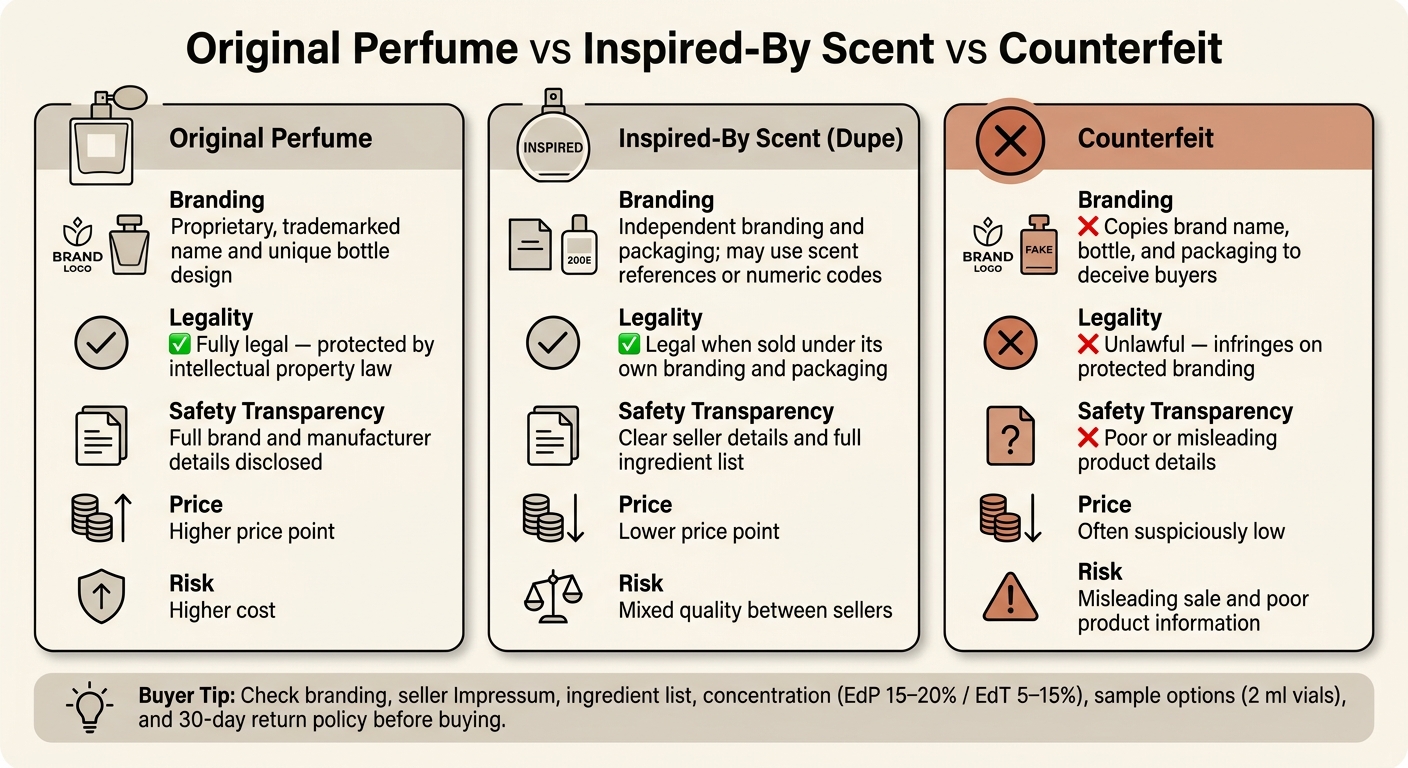
Comparison Table: Original Perfume, Inspired-By Scent, and Counterfeit
Perfume Dupes vs Inspired-By Scents vs Counterfeits: Key Differences
This table gives you a quick side-by-side look at the three main fragrance types.
Factor
Original Perfume
Inspired-By Scent (Dupe)
Counterfeit
Branding
Proprietary, trademarked branding and a one-of-a-kind bottle design
Independent branding and packaging; may use scent references or numeric codes
Copies the brand, bottle, and packaging to deceive buyers
Legality
Legal branded product protected by intellectual property
Legal when it uses its own branding and packaging
Unlawful because it copies protected branding
Safety transparency
Full brand and manufacturer details
Clear seller details and ingredient list
Poor or misleading product details
Conclusion
Perfume dupes aren't automatically counterfeits. The line is pretty simple: honest branding and clear selling.
So what should shoppers check before buying?
Start with the seller's trader status. If that's clear, then the choice comes down to value, honesty, and scent quality.
When a fragrance brand is upfront, an inspired-by scent can make sense as an everyday option. Mr. Dupe is one example of a transparent EU-based store.
FAQs
How can I spot a fake perfume online?
Check the retailer first. Unauthorised sellers are a common source of counterfeit goods, so this step matters more than most people think.
Genuine products usually come with high-quality packaging, consistent branding, and pricing that fits normal market expectations. If something looks off, feels cheaply made, or is priced far below what you'd expect, that's often a red flag.
For inspired-by fragrances, trusted retailers such as Mr. Dupe offer a transparent alternative to illicit counterfeits.
Why do some dupes last longer than others?
Longevity mostly comes down to two things: fragrance concentration and the quality of the fragrance oils. Scents with a higher share of perfume oil usually stay on the skin longer than fragrances with more alcohol.
That’s why wear time can differ from one dupe to another. High-quality inspired-by scents from Mr. Dupe use premium ingredients to deliver strong, long-lasting performance.
Are perfume dupes legal in Germany and the EU?
Yes - in Germany and the EU, perfume dupes are legal when sold as inspired-by alternatives, not as counterfeits.
Illegal imitations copy trademarks or branding to mislead customers. Inspired-by fragrances recreate a scent profile while keeping their own branding and identity. Mr. Dupe offers a clear way to enjoy familiar fragrance styles legally and at a lower price.