Perfumer Work in Grasse: Study Summary | mr. dupe | mr. dupe
guides
Perfumer Work in Grasse: Study Summary
Judge perfumes by materials, training, and skin wear — not price.
by mr. dupe editorial, fragrance editors·
If you want to judge a perfume well, don’t start with price. Start with materials, training, and skin wear. That is the main point here.
I see this study summary as a simple chain:
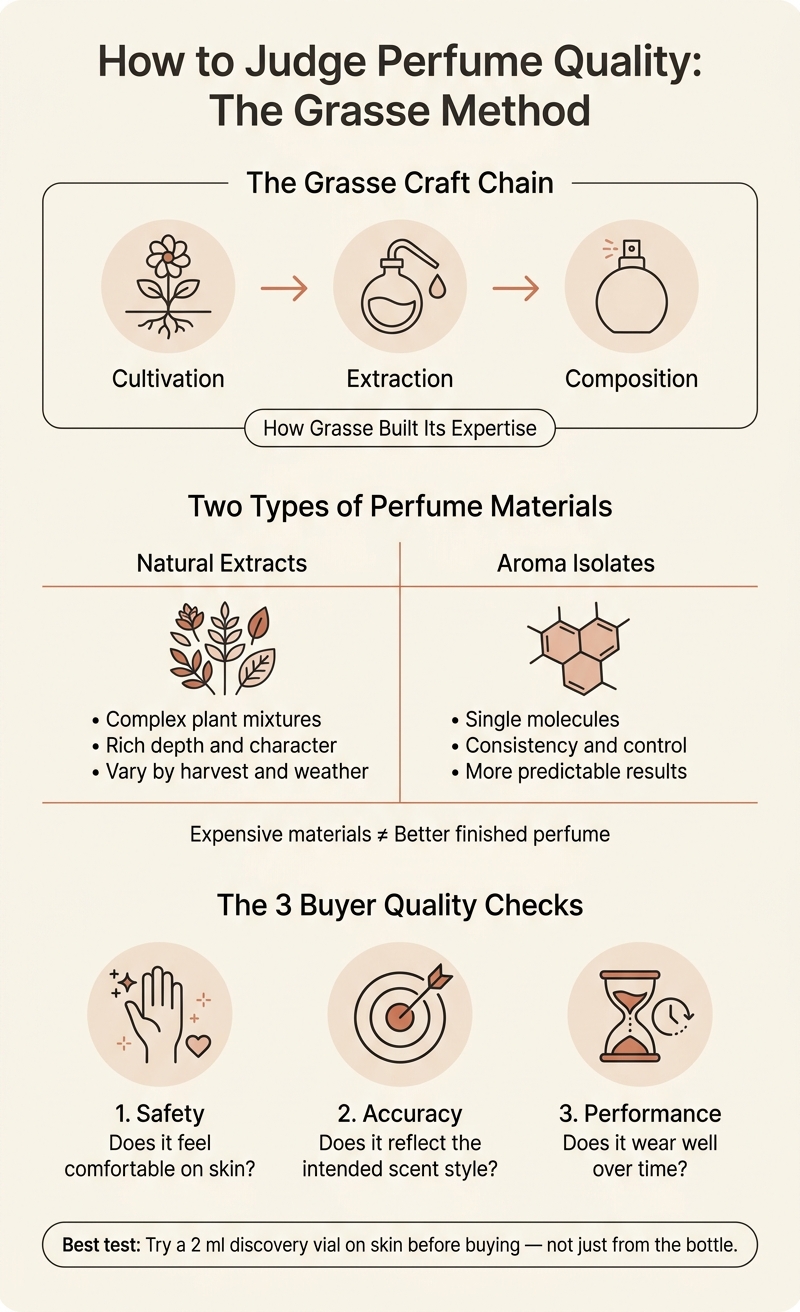
Grasse became a perfume centre through 3 linked parts: growing plants, extracting scent, and building formulas.
Raw materials vary: weather, harvest time, and process can change the smell by a lot, even when the plant is the same.
Training matters: perfumers learn blind smelling, scent memory, and how a fragrance changes from opening to dry-down.
Finished perfume quality is not the same as material cost: a rare or high-cost material can still do little for the final result.
For inspired-by perfumes, 3 checks matter most:safety, accuracy, and performance.
The easiest test is still skin testing: a 2 ml vial can tell you more than a few seconds from the bottle.
Here’s the short version: Grasse still matters because it links raw material work, formula building, and wear on skin. I’d use that chain to judge a fragrance, not marketing claims.
Quick take:
Best signal of quality: how the perfume wears over time
Grasse became a perfume centre through cultivation, extraction, and composition know-how. Those three parts worked together and turned the town into a place closely tied to fragrance.
At first glance, that might sound simple. It wasn't. Growing flowers is one thing. Pulling scent from them is another. Then comes composition: blending raw materials into a finished perfume that smells balanced, rich, and memorable.
That deep craft base mattered. It helped shape the raw-material standards discussed next.
Raw materials, extraction, and what quality means in practice
Natural materials come from plant matter like flowers, peels, resins, and other sources. And they don't smell exactly the same every time. Harvest timing, weather, and source quality all shape the final scent.
The two main material types here are natural extracts and aroma isolates.
How cultivation and extraction affect smell
How a plant is grown shapes its raw smell. Then the extraction method changes which parts of that smell make it into the final material. Same plant, different process, different result.
Material Category
What It Is
Use
Natural extracts
Complex mixtures of many molecules from plants
Bring depth and character; vary by harvest and weather
Aroma isolates
Single molecules from natural sources
Give perfumers more control and consistency
That said, good raw materials don't automatically lead to a good finished perfume. That's where people often mix things up.
Raw-material quality is not the same as finished-perfume quality
Natural extracts and isolates do different jobs in a formula. Their worth depends on how they behave once they're part of that formula.
A material can be expensive, rare, or carefully sourced and still not improve the finished perfume. What matters is whether it helps the composition smell better, last better, or do the job the perfumer wants it to do.
Perfumer training and house methods
What perfumers learn in Grasse-based training
Knowing raw materials is only the starting point. It becomes useful when perfumers learn how to control those materials in a formula.
Training in Grasse often starts with the Jean Carles method. The idea is simple: build olfactory memory through blind testing, over and over again. Students smell hundreds of natural and synthetic materials without seeing their names and learn to identify them with consistency. They also learn a shared scent vocabulary, which helps them describe what they smell in clear terms.
Perfumers also study how a fragrance changes as it wears. That includes evaporation behaviour and the way top, heart, and base notes develop over time. This part of training shapes three things that matter a lot in the finished perfume:
Balance
Diffusion
Longevity
From brief to bottle: the standard workflow
Modern inspired-by perfumery usually follows a clear path: brief, trial formula, evaluation, revision, and bottling.
What Grasse know-how means for inspired-by perfumes today
Inspired-by perfumes are original compositions built around a recognisable scent style. That point matters because it changes the conversation. The focus is not on copying. It’s on how the formula is built.
That’s also why Grasse-trained methods still shape the way many modern perfumes are judged. If you want to assess an inspired-by perfume properly, look at three things: safety, scent match, and wear.
Safety: Does it feel comfortable on your skin?
Accuracy: Does it reflect the intended scent style well?
Performance: Does it wear in a balanced way over time?
In day-to-day use, that means one simple thing: test the fragrance on skin before you buy. A perfume can smell great from the bottle and then act very differently once it meets your skin. Mr. Dupe composes and bottles fragrances in Grasse and offers free 2 ml discovery vials for skin testing before purchase.
How to judge scent quality without relying on price
Price on its own is a weak signal. An expensive perfume can still miss the mark, and a lower-priced one can wear well. A better way to judge scent quality is to check the fragrance against the three points above: safety, scent match, and wear.
A discovery vial helps because it shows you what happens in normal use. You’re not just smelling the opening for a few seconds. You get to see how the perfume settles, changes, and lasts on your skin over time.
Final summary: Grasse's lasting value for modern fragrance buyers
This craft standard is why Grasse still matters to buyers of inspired-by perfumes. It connects the full chain: raw materials, composition, and wear. And that chain is what tells you whether a perfume was put together with care and whether it performs well once you start wearing it.
FAQs
Why is Grasse still important in perfumery?
Grasse still matters in perfumery. It’s the historic cradle of the craft, where raw-material sourcing and perfumer training were shaped and refined over time. That legacy still sets the bar for scent quality today.
At Mr. Dupe, we honour this heritage with inspired-by perfumes that reflect the sophistication of these classic techniques at a fraction of the cost.
How does skin chemistry change a perfume?
The available search results don’t explain how skin chemistry affects a perfume.
So, based on the source material provided, this question isn’t answered.
What makes a perfume high quality?
Great perfume comes down to three things: how it’s built, the raw materials used, and how it unfolds on your skin. When a fragrance is made well, it feels balanced, layered, and long-lasting.
At Mr. Dupe, we think that standard shouldn’t be limited to a small group of people. Our inspired-by perfumes bring the feel of premium craftsmanship into reach, so you can enjoy a polished, sophisticated fragrance experience.