Why Perfume Dupes Smell Different Across Batches | mr. dupe | mr. dupe
guides
Why Perfume Dupes Smell Different Across Batches
Why perfume dupe batches can smell different—ingredient or formula changes, maceration, or poor storage—and how to sample first.
by mr. dupe editorial, fragrance editors·
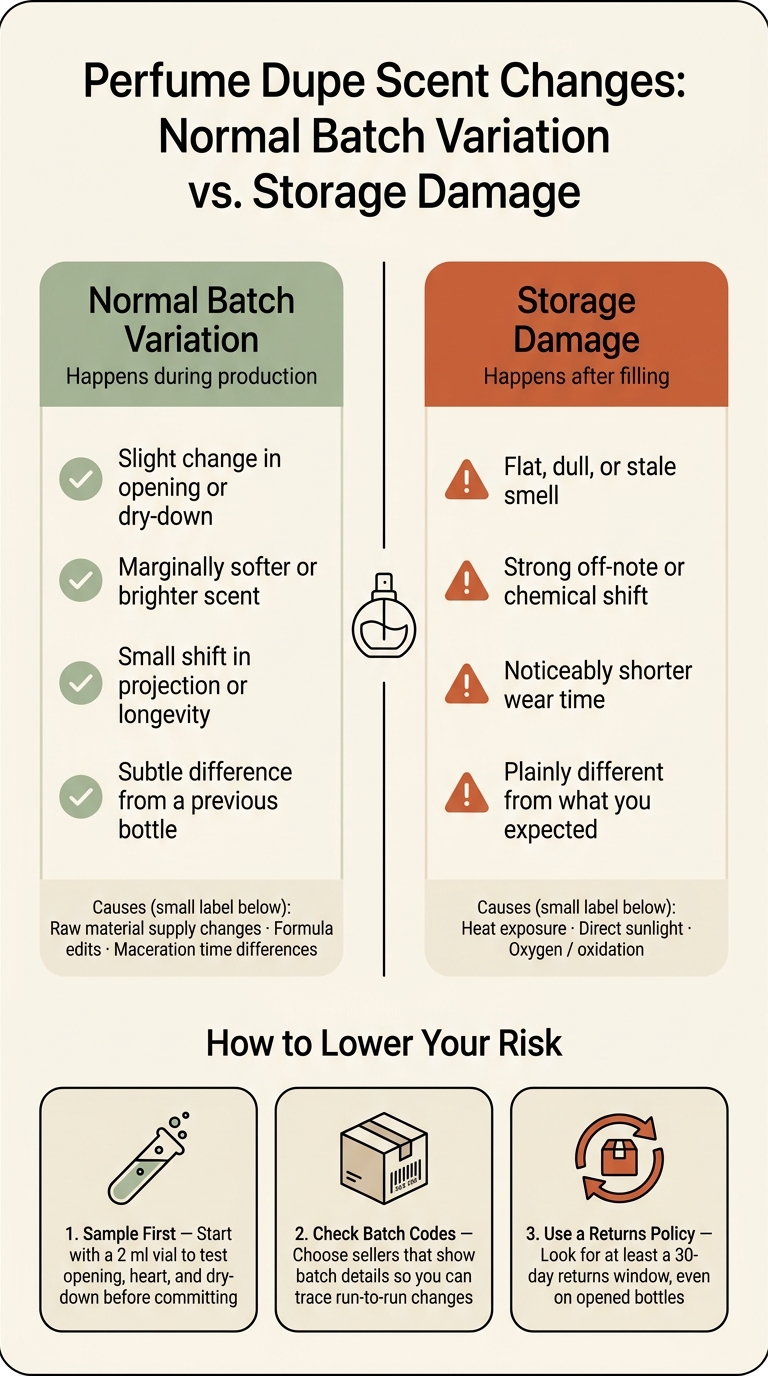
Yes - the same dupe can smell a bit different from one bottle to the next. In most cases, that comes down to raw material changes, small formula edits, maceration time, or poor storage after filling.
If I want to keep risk low, I focus on a few simple checks first:
Small scent shifts are normal
Big changes can point to heat, light, or oxidation
Top notes and dry-down often show the biggest differences
A 2 ml sample is often enough for several test wears
A clear returns window, like 30 days, gives me a backup plan
In short: if a bottle smells a little brighter, softer, or shorter-lived, that may be normal. If it smells flat, stale, or far off, I’d suspect storage damage instead of batch drift.
What I notice
What it often means
Slight change in opening or dry-down
Normal batch variation
Weaker projection or shorter wear
Raw material shift, formula edit, or ageing
Flat, dull, stale smell
Heat, light, or oxygen damage
Strong difference from past bottle
Batch change or bad storage
That’s the main point of this article: not every difference is a problem, but some are. I’d sample first, store bottles away from heat and light, and buy from a seller that shows batch details and allows returns before spending more than €0 on a trial or more on a full bottle.
Perfume Dupe Batch Changes: Normal vs. Damaged
Why batches change: ingredients, regulations, and production
Those differences usually come from three places: ingredients, regulation, and production.
Raw material supply can change a scent profile because naturals, aroma chemicals, and solvents vary by source, harvest, and purity. One batch may smell a bit brighter, sweeter, or smoother than another for that reason alone.
EU and IFRA rules can also force formula changes. And those changes may shift the opening, sweetness, projection, or dry-down of a dupe.
Production matters too. Blending time, fill timing, and maceration all affect how a batch smells when it reaches the customer.
And it doesn’t stop at filling. Heat, light, and oxygen can still change how the bottle smells after it’s been packed and shipped.
the scent. none of the markup.
the same fragrances you already know, interpreted honestly and priced without the label tax.
Why bottles can change after they leave the factory
Bottles don’t stop changing the moment they’re filled. Once they leave the factory, shipping, warehouse storage, and even home storage can affect what’s inside. If a bottle is exposed to heat, light, or oxygen, the scent may shift over time.
Heat, light, and oxygen can flatten or distort a fragrance
Heat, light, and oxygen are the main drivers of post-fill scent change. Temperature swings and direct sunlight can speed up oxidation, which breaks down delicate top notes. That’s often when a fragrance starts to smell flatter, duller, or slightly off.
Oxygen plays a part too. Even the air sitting in the bottle can push chemical breakdown forward, especially over time.
How to tell storage damage from true batch variation
Storage damage happens after filling. True batch variation happens during production. That difference matters, because it helps you work out whether the issue came from handling and storage or from the batch itself.
How to lower batch risk before and after buying
If the issue might come from the batch or from storage, the safest step is simple: test before you commit.
Sample first and test on skin over several days
The best way to lower risk is to start with a 2 ml sample. A 2 ml vial gives you enough wear time to test the opening, the heart, and the dry-down. That makes a small sample far more useful than bottle photos or note lists on their own.
It also helps to wear the scent across several days. Fragrance can shift a lot depending on temperature, humidity, and your skin chemistry. A perfume that feels smooth one day can come across very differently on another.
Mr. Dupe offers free 2 ml discovery vials (€0), so you can test a fragrance on your skin before committing to a full bottle.
Use note filters, scent families, and scent matching to choose more accurately
You can also cut down the guesswork before buying. Use scent-family, note, and inspiration filters - or Mr. Dupe's scent finder - to narrow your options.
Mr. Dupe's scent finder lets you enter notes, moods, and fragrances you like, then suggests matches from its catalogue. Pair that with filters for occasion and season, and you get a much clearer starting point. That can help reduce costly blind buys.
Choose an EU-based house with clear controls and a returns policy
If you want fewer surprises, pick a seller that shows batch codes and accepts returns. Buy from a house that tracks batches and gives you a clear returns policy. An EU-based seller can also cut customs delays and make returns easier.
Visible batch coding is a practical sign that a house tracks its production runs. Batch codes help you trace run-to-run changes. Returns give you cover if a bottle smells off.
Mr. Dupe is made and bottled in Grasse, France, and offers 30-day returns, even on opened bottles.
Sampling, batch codes, and clear returns all help lower the chance of a bad buy.
Conclusion: What scent changes are normal and how to buy with more confidence
Small-batch scent shifts are normal. They often come down to ingredient variation, small formula changes, maceration, or storage. That said, not every change should be brushed off.
If a bottle smells flat, stale, or plainly different from what you knew before, it may be storage damage rather than normal batch drift.
The safest move is pretty simple: sample first, keep bottles away from heat and light, and buy from a seller that gives clear batch details and a fair returns policy. Unlike vague marketplace sellers, Mr. Dupe offers free 2 ml discovery vials (€0), fragrances made and bottled in Grasse, France, 30-day returns on opened bottles, and EU shipping without customs surprises.
Knowing what causes these changes helps you sample smarter and buy with less risk.
FAQs
How much batch variation is normal?
Minor batch variation is normal in fragrance. Raw materials and layered scent builds can shift a bit based on source, storage conditions, and natural variation. Perfect consistency is rare.
Some fragrance houses also make small formula changes for legal or cost reasons. At Mr. Dupe, we keep our standards high so each inspired-by scent stays close to the character you expect.
Can maceration change how a dupe smells?
Yes. Maceration can change the final scent profile of inspired-by perfumes in a big way. It gives the aromatic molecules time to blend, settle, and work together.
Without enough maceration, a fragrance can smell sharp, uneven, or chemically off because the notes haven’t fully come together yet. At Mr. Dupe, proper maceration helps each batch reach its intended depth and complexity.
How should I store perfume dupes properly?
Store your fragrances in a cool, dark spot, like a drawer or cupboard, away from direct sunlight and shifting temperatures. Heat and light can wear down delicate ingredients and change the scent over time.
To help preserve every note, keep bottles upright and tightly sealed. Mr. Dupe fragrances are made with care to last, but proper storage still makes a difference.